EVERYTHING DDRU
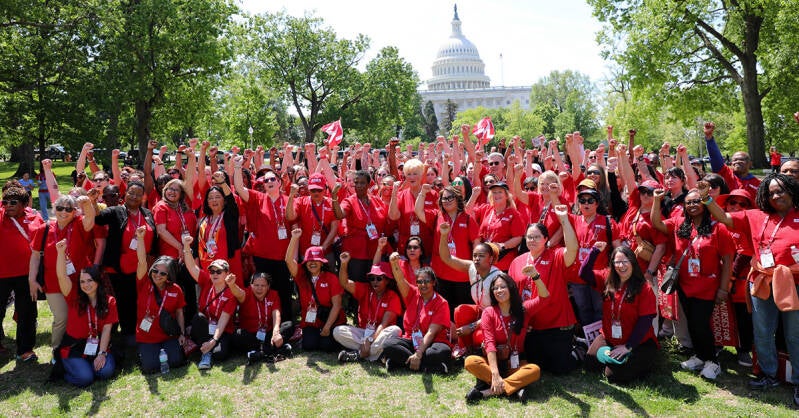
As Medicaid funding changes threaten to put pressure on healthcare providers, DDRU calls on Miami-Dade, Broward, and Palm Beach County caregivers to prepare for the future, protect their careers, and connect with employment opportunities.
SOUTH FLORIDA CAREGIVERS: DON'T WAIT FOR A LAYOFF TO MAKE YOUR NEXT MOVE! JOIN DDRU AND GET CONNECTED TO OPPORTUNITIES.
MIAMI, FLORIDA — OCTOBER 26, 2026 — South Florida's CNAs, Home Health Aides (HHAs), nursing assistants, and independent caregivers are being urged to take a serious look at their employment future. DDRU of America is expanding its message to workers across Miami-Dade, Broward, and Palm Beach counties: now is the time to join together, explore your employment options, and prepare for changes in the healthcare industry.
The federal healthcare landscape is changing. President Donald Trump's One Big Beautiful Bill Act, signed into law in July 2025, includes major Medicaid funding reductions and eligibility changes that will be implemented over time. Analysts warn that financial pressure on state Medicaid programs could affect provider reimbursement, healthcare services, and access to care. The full impact will depend on how Florida and individual healthcare providers respond.
For direct-care professionals, these developments raise serious questions: What happens if a facility reduces staffing? What happens if a home-health agency loses funding or cuts assignments? And where does a caregiver turn when a regular client can no longer afford private care?
DDRU of America believes workers should prepare before a crisis arrives—not after their hours have been cut or their assignment has ended.
SOUTH FLORIDA'S CAREGIVERS CANNOT AFFORD TO BE OVERLOOKED
From Miami and Hialeah to Fort Lauderdale, Hollywood, West Palm Beach, and surrounding communities, direct-care workers provide essential services to seniors, people with disabilities, and families who need assistance at home.
CNAs and HHAs help people with everyday activities, personal care, mobility, and other essential needs. Independent caregivers often develop close relationships with the families they serve, sometimes providing support that allows loved ones to remain in their homes.
But the work can be financially uncertain. An assignment can end. A family can lose the ability to pay privately. An agency can change its staffing needs. A facility can reduce hours.
When a worker depends on a single employer or client for income, losing that opportunity can create an immediate financial emergency.
That is why DDRU is encouraging South Florida's direct-care workforce to build professional connections and explore additional employment opportunities before they need them.
THE BIG BEAUTIFUL BILL: WHY WORKERS SHOULD PAY ATTENTION
The One Big Beautiful Bill Act is not a blanket order to lay off nurses, CNAs, or HHAs. However, its Medicaid changes are expected to place pressure on healthcare financing over time.
Healthcare policy researchers warn that states facing Medicaid budget pressure may consider changes to provider payments, covered services, or eligibility. Such responses could create challenges for providers and workers in some parts of the healthcare system.
For South Florida caregivers, the concern is what happens if an employer faces tighter budgets or a family has fewer resources to pay for care.
If reimbursement rates fail to cover the cost of providing services, agencies may struggle to recruit and retain workers or maintain the same level of service. If families cannot afford private caregiving, some may have to reduce the hours of assistance they purchase.
The risk is not simply about jobs. It is also about whether seniors and vulnerable people can continue receiving the care they need.
DDRU believes Florida must protect its direct-care workforce, strengthen sustainable funding for home-based services, and recognize that quality care depends on having qualified workers available.
DDRU'S ANSWER: HELP MEMBERS STAY CONNECTED TO WORK
DDRU of America is building a job-coordination approach designed to help members explore opportunities beyond one employer or one location.
Through the union's employment-coordination process, members can share their qualifications and preferences so DDRU can work with them to identify opportunities that may be a fit.
These opportunities may include:
* Local South Florida employment: Positions and assignments in Miami-Dade, Broward, Palm Beach, and nearby areas, depending on availability.
* Travel healthcare assignments: Opportunities for qualified workers who are willing and able to travel.
* Home-health and private-duty work: Potential assignments serving people who need assistance in their homes.
* Independent caregiving gigs: Opportunities for qualified caregivers to connect with work that fits their experience and availability.
* Permanent placement: Employment opportunities for workers seeking a longer-term position.
* Four-to-six-month assignments: Temporary assignments, with the possibility of exploring another placement or requesting an extension when available.
DDRU encourages members to communicate their preferred work locations, shifts, certifications, experience, and availability clearly.
The union's goal is to help members remain connected to opportunities and reduce avoidable gaps between assignments. Employment depends on available positions, employer requirements, and the member's qualifications; DDRU cannot guarantee continuous work or a particular wage.
Instead of facing every employment change alone, DDRU members can connect with the union's job-coordination process and explore their next move.
INDEPENDENT CAREGIVERS: YOUR SKILLS HAVE VALUE
South Florida has families searching for reliable care for aging parents, loved ones with disabilities, and people who need assistance with daily living.
Independent CNAs, HHAs, and other qualified care professionals may have the flexibility to pursue private-duty, home-health, or travel opportunities. But independence can also mean having to find clients, negotiate terms, manage cancellations, and replace lost income when a caregiving arrangement ends.
DDRU wants independent care professionals to explore whether membership and access to job coordination can help them expand their employment options.
The union also recognizes that private care can be expensive. Families without sufficient financial resources may struggle to pay out of pocket for the hours of care their loved ones need.
A family's ability to obtain essential care should not depend entirely on how wealthy that family is.
DDRU supports efforts to strengthen the direct-care workforce, improve worker compensation, and encourage healthcare policies that make quality care more accessible.
WHY JOIN DDRU NOW?
DDRU is asking South Florida's CNAs and HHAs to stop putting off the conversation about their employment future.
Joining a union does not eliminate every workplace risk, and no organization can promise that every member will always have an assignment. But taking action now can help workers learn about available resources, understand membership options, and establish connections before an unexpected employment change occurs.
DDRU membership is advertised for as little as $40 per month. Prospective members should confirm current dues, membership terms, and available job-coordination services directly with DDRU.
To get started:
1. Contact DDRU of America. Ask about membership and the job-coordination process.
2. Email your professional resume. Include your certifications, experience, work history, and availability.
3. Explain what type of work you want. Tell DDRU whether you are seeking permanent placement, local South Florida work, travel assignments, home-health opportunities, independent caregiving gigs, or four-to-six-month assignments.
4. Keep your professional documents current. Make sure your certifications and other required qualifications are ready for prospective employers.
5. Stay engaged. Follow DDRU's announcements and communicate with the union about your employment goals.
DDRU'S MESSAGE TO MIAMI, BROWARD, AND PALM BEACH
DDRU of America believes the people who care for South Florida's seniors and vulnerable residents deserve more than uncertainty. They deserve fair treatment, competitive compensation, meaningful workplace protections, and opportunities to build sustainable careers.
The union continues to advocate for stronger wages and benefits, better employment opportunities, and greater recognition for CNAs, HHAs, nursing assistants, medical assistants, and other direct-care professionals.
DDRU has also proposed the Florida Direct Care Healthcare Workforce Wage Act, which calls for a $35-per-hour starting wage for covered direct-care workers. That proposal is an advocacy goal, not a current statewide wage requirement.
For South Florida's healthcare workforce, the message is urgent: prepare now, learn your options, and build connections before you need them.
When an assignment ends, what is your next move? When an employer cuts hours, where will you turn? When a family can no longer afford private care, how will you replace that income?
DDRU wants workers to begin asking these questions today.
SOUTH FLORIDA, THE TIME TO GET CONNECTED IS NOW!
Join DDRU of America. Submit your resume. Tell us what kind of work you want. Explore opportunities through our job-coordination process.
DDRU of America — One Voice. One Union. Better Future.
🌐 Website: www.DDRU.org
📧 Email: Admin@DDRU.org
📞 Phone: (904) 689-4031
DDRU of America: Advocating for the workers who care for our communities and working to connect direct-care professionals with employment opportunities.

As federal healthcare funding changes put pressure on Medicaid and healthcare providers, DDRU of America urges CNAs, HHAs, and independent care professionals to prepare, protect their careers, and build stronger connections to employment opportunities.
HEALTHCARE WORKERS: DON'T WAIT UNTIL YOU LOSE YOUR JOB TO LOOK FOR PROTECTION! DDRU OF AMERICA SAYS THE TIME TO JOIN IS NOW!
ST. AUGUSTINE, FLORIDA — What happens when healthcare budgets tighten, employers face financial pressure, and the workers who provide essential hands-on care find themselves competing for fewer hours and fewer jobs?
For Certified Nursing Assistants (CNAs), Home Health Aides (HHAs), nursing assistants, and independent healthcare workers, the answer cannot be to wait until the last paycheck is threatened before looking for support.
DDRU of America is calling on direct-care professionals to take action now: join the union, connect with job coordinators, and prepare for a changing healthcare employment landscape.
THE WARNING: HEALTHCARE FUNDING CHANGES COULD AFFECT WORKERS AND FAMILIES
President Donald Trump's One Big Beautiful Bill Act became law on July 4, 2025. The law includes substantial changes to Medicaid financing, eligibility, and provider payments. The Congressional Budget Office has projected major reductions in federal Medicaid spending over the coming decade and an increase in the number of Americans without health insurance. These changes could place additional pressure on parts of the healthcare system, although the effects will vary by state, provider, and type of service.
For direct-care workers, these developments raise important questions about staffing, available hours, home-care services, and the financial stability of healthcare employers.
It is important to understand that widespread CNA and HHA layoffs are not inevitable or confirmed across the industry. But when reimbursement changes and financial pressures affect an employer, workers need to be prepared for possible changes in schedules, staffing needs, and job availability.
DDRU believes CNAs and HHAs cannot afford to ignore these risks.
These are the workers who help seniors bathe, dress, eat, move safely, recover after illness, and remain in their homes. When families need care for an aging parent or a loved one with disabilities, direct-care professionals often make the difference between maintaining independence and needing a higher level of care.
Yet the people performing this essential work can be financially vulnerable when hours are reduced or assignments end.
WHY DDRU SAYS THE TIME TO JOIN IS NOW
DDRU of America is building a union-centered approach to help members connect with employment opportunities, including in-state assignments, travel healthcare opportunities, and independent home-health and caregiving gigs where available.
The union's goal is to help qualified members find opportunities that match their experience, certifications, location preferences, and availability.
Through DDRU's job-coordination approach, members can pursue opportunities beyond a single facility or employer instead of relying on only one workplace for their income.
DDRU encourages members to communicate clearly with job coordinators about the kind of work they want, including:
-
Permanent placement opportunities.
-
Four-to-six-month assignments, where available.
-
Travel healthcare assignments that match their qualifications.
-
Home-health and private-duty caregiving opportunities.
-
Independent caregiving gigs and flexible assignments.
-
Opportunities to transfer to another assignment when a current placement ends.
For members working on a temporary assignment, DDRU can help them explore another opportunity or inquire about extending their current placement when the employer and assignment terms allow it. No assignment, extension, or uninterrupted employment can be guaranteed, but DDRU's stated goal is to help members stay connected to work and reduce avoidable gaps between assignments.
INDEPENDENT CAREGIVERS: YOU SHOULD NOT HAVE TO BUILD YOUR CAREER ALONE
Independent CNAs, HHAs, and other qualified care professionals may seek private clients, travel assignments, or flexible home-health work. While independence can create opportunities, it can also leave workers responsible for finding clients, negotiating rates, managing scheduling changes, and replacing lost income when a client no longer needs care.
DDRU wants independent care professionals to explore whether union membership and job coordination can help them expand their employment options.
The union also recognizes the challenges families face when they need reliable care but cannot afford substantial out-of-pocket costs. If public funding or insurance coverage does not adequately support a person's care needs, families may be forced to make difficult decisions about how much help they can afford.
DDRU believes access to quality care should not depend solely on whether a family has enough money to pay privately. Protecting the direct-care workforce and supporting sustainable ways to pay for care must be part of the broader conversation.
WHAT DDRU MEMBERS SHOULD DO TODAY
DDRU encourages CNAs and HHAs who are concerned about their employment future to take practical steps now.
Step 1: Connect with DDRU. Learn about union membership and the job-coordination process. Membership is advertised by DDRU for as little as $40 per month; prospective members should confirm current dues and membership terms directly with the union.
Step 2: Prepare your professional resume. Include your certifications, work history, experience, preferred locations, availability, and the types of assignments you are qualified to accept.
Step 3: Tell DDRU what kind of work you want. Explain whether you are seeking permanent placement, local work, travel assignments, home-health gigs, or four-to-six-month assignments.
Step 4: Keep your qualifications current. Maintain required credentials and be ready to provide any documentation an employer needs to verify your eligibility for a position.
Step 5: Do not wait for a layoff notice to explore your options. Building professional connections and learning about available opportunities before a job ends can put you in a better position to respond to a change in circumstances.
DDRU'S MISSION: PROTECT WORKERS, SUPPORT FAMILIES, AND STRENGTHEN THE CARE WORKFORCE
DDRU of America says its mission goes beyond helping members find their next assignment. The union advocates for better wages, benefits, workplace protections, professional recognition, and educational advancement for CNAs, HHAs, nursing assistants, medical assistants, and other direct-care professionals.
DDRU has also promoted a proposed Florida Direct Care Healthcare Workforce Wage Act calling for a $35-per-hour starting wage for covered direct-care workers. That is a legislative proposal, not an established statewide wage requirement.
The union believes better compensation and a more stable workforce are essential to attracting and retaining the people who care for Florida's seniors, people with disabilities, and families who depend on home-based support.
When workers have better access to opportunities and a stronger voice in their working conditions, they may be better equipped to navigate employment changes. When families have access to qualified caregivers, they have more options for arranging care for loved ones.
DDRU's message is that worker protection and patient care are connected.
THE BOTTOM LINE: PREPARE NOW — NOT AFTER THE PAYCHECK STOPS
No union can promise that every member will avoid layoffs, that every assignment will be available, or that a job will always be waiting. But workers can take steps to prepare for uncertainty, build their professional networks, and seek support rather than face every employment challenge alone.
DDRU of America is urging CNAs, HHAs, and independent care professionals to learn about membership, submit their resumes, and connect with its job-coordination team.
If you are worried about changing healthcare budgets, reduced hours, or what happens when a client or assignment ends, start asking questions now.
Don't wait until your job is gone to begin planning your next move.
JOIN DDRU OF AMERICA
DDRU of America — One Voice. One Union. Better Future.
Website: www.DDRU.org
Email: Admin@DDRU.org
Phone: (904) 689-4031
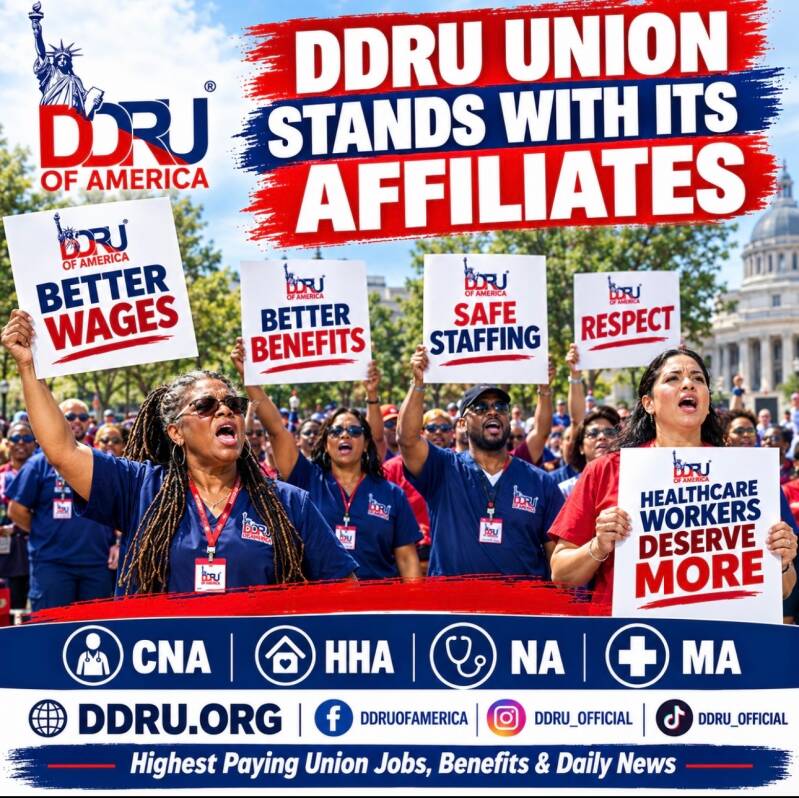
DDRU OF AMERICA STANDS IN SOLIDARITY WITH UF HEALTH WORKERS DEMANDING FAIR TREATMENT
DDRU President and members join the call for workplace respect, fair labor practices, and stronger protections for healthcare workers in Jacksonville.
JACKSONVILLE, FLORIDA — Healthcare workers deserve respect, fair treatment, and a voice in decisions that affect their livelihoods. That is the message behind a recent rally outside UF Health Jacksonville, where nearly two dozen employees gathered to demand better treatment from their employer, with DDRU of America and its members present to show their support and solidarity.
According to a report from our partners at Jax Today, the workers, represented by two labor unions, filed an Unfair Labor Practice complaint with the National Labor Relations Board in September. The complaint alleges that UF Health refused to bargain with them as their labor contract approaches expiration.
The unions represent nurses, therapists, CNA's, other patient-facing professionals, and food service and support employees — workers whose contributions help keep healthcare facilities operating and patients receiving care.
A Fight Over Paid Time Off and Workers’ Rights
One of the central concerns raised by the workers is UF Health’s proposal to eliminate 40 hours of paid time off for union members before the holiday season.
Workers say they often rely on that paid time off to supplement lost wages when they are sent home early because the hospital is not busy. Losing those hours could place additional financial pressure on employees who depend on their earnings to support themselves and their families.
UF Health has stated that it is “committed to providing competitive compensation and benefits.”
The dispute highlights a broader issue facing healthcare employees: workers who dedicate themselves to caring for others also need stability, fair compensation, and meaningful representation in the workplace.
DDRU of America Shows Up for Healthcare Workers
DDRU joined the show of support because the union believes that healthcare workers should not have to stand alone when confronting workplace concerns.
DDRU advocates for better wages, stronger benefits, fair treatment, and greater recognition for the professionals who provide essential healthcare services. While the circumstances of each workplace dispute are different, DDRU believes workers deserve the opportunity to raise concerns, participate in good-faith labor discussions, and seek fair solutions through appropriate labor processes.
For DDRU, showing up matters. Solidarity means standing beside workers who are speaking out about their working conditions and demonstrating that the healthcare workforce deserves a voice.
DDRU’s message is clear: the people who care for our communities deserve to be treated with dignity, fairness, and respect.
A Stronger Voice for Healthcare Workers
The UF Health rally reflects the importance of worker representation and the role organized labor can play in bringing workplace concerns into public view. As the dispute moves forward, the workers’ allegations and the hospital’s position will be important to the ongoing discussion.
DDRU of America encourages healthcare professionals to learn about their workplace rights, understand their options for representation, and remain engaged in efforts to improve wages, benefits, and working conditions across the healthcare industry.
DDRU is especially committed to ensuring that certified nursing assistants, home health aides, nursing assistants, medical assistants, and other direct-care professionals are not overlooked in conversations about the future of healthcare.
The union believes that a stronger healthcare system must include a stronger workforce — one in which employees can pursue stable careers, support their families, and be recognized for the essential work they perform every day.
DDRU of America: One Voice. One Union. Better Future.
DDRU of America will continue to support efforts that advance fair treatment, workplace protections, competitive wages, and dignity for healthcare workers.
Because standing up for the people who care for others is not simply a slogan. It is a commitment to action.
“We can’t talk about it. We have to be about it.”
— Mr Bass, DDRU of America
Learn more or connect with DDRU:
Website: www.DDRU.org
Email: Admin@DDRU.org
Phone: (904) 689-4031

FLORIDA’S HEALTHCARE WORKERS ARE READY TO FIGHT BACK: 5,000+ CNAs AND HHAs COULD JOIN A HISTORIC LABOR BATTLE — DDRU DEMANDS $35 AN HOUR!
“PAY US WHAT WE’RE WORTH — OR PREPARE TO TAKE CARE OF YOUR OWN PATIENTS!” DDRU President Mr. Bass Warns Healthcare Facility Owners as Thanksgiving Deadline Approaches
ST. AUGUSTINE, FLORIDA — A new labor battle could be brewing across Florida’s healthcare industry, and this time, the workers demanding change are the Certified Nursing Assistants (CNAs) and Home Health Aides (HHAs) who provide essential hands-on care to patients every single day.
DDRU of America, the CNA/HHA nursing union led by President Mr.Bass, is calling for a historic movement to bring Florida’s direct-care workforce together in the fight for higher starting wages, better benefits, improved working conditions, and the respect these essential healthcare professionals deserve.
With more than 5,000 CNAs and HHAs, as a organizing force, DDRU is preparing to build a stronger statewide movement inspired by the determination and collective power demonstrated by its labor allies, including National Nurses United (NNU) and the Massachusetts Nurses Association (MNA).
The message from DDRU leadership is unmistakable: Florida’s direct-care workers can no longer afford to wait for the healthcare industry to do the right thing.
PRESIDENT Mr. BASS Stated “THE GAMES ARE OVER!”
Mr. Bass says the fight for better wages is about more than a paycheck. It is about dignity, economic security, professional recognition, and the future of the people who keep healthcare facilities operating.
“I'm calling on CNAs and HHAs across Florida to stand together and demand what we deserve. We are the people helping patients bathe, dress, eat, move safely, and maintain their dignity. We are there when families need help caring for the people they love. We carry enormous responsibilities, yet too many direct-care workers struggle to make ends meet.
“I have learned from some of the strongest labor leaders in the country, including leaders associated with our affiliates at National Nurses United and the Massachusetts Nurses Association. I have seen the importance of organizing, solidarity, collective action, and refusing to allow essential workers to be overlooked.
“Now I want to help bring that same spirit of unity to Florida's CNAs and HHAs. We are not asking for special treatment. We are demanding fair treatment.
“Our goal is a $35-an-hour starting wage, better benefits, and meaningful workplace protections for CNAs and HHAs. These workers deserve the opportunity to support their families without having to work themselves into exhaustion just to survive.”
Bass says DDRU intends to put direct-care workers at the center of the conversation about Florida's healthcare workforce and the future of patient care.
The labor movement has repeatedly demonstrated that when healthcare workers organize around common demands, employers must take their concerns seriously.
Major nurse labor disputes, including high-profile negotiations and strike actions involving registered nurses, have brought national attention to questions of staffing, compensation, working conditions, and patient safety.
DDRU believes Florida's CNAs and HHAs deserve the opportunity to organize with comparable determination.
Although registered nurses and direct-care workers have different professional roles, they share an important reality: healthcare depends on workers who are properly supported, fairly compensated, and able to raise concerns about the quality of care.
Bass says the objective is not to divide healthcare workers by job title. It is to ensure that CNAs and HHAs are no longer left out of conversations about healthcare labor standards.
“We respect our registered nurses and the battles they fight. Our affiliates and labor allies have shown what organized workers can accomplish. But we must also recognize the CNAs and HHAs who work alongside other healthcare professionals and provide the daily hands-on care patients depend on.
“It's time for our workers to have a stronger voice. It's time for us to organize. And it's time for employers to understand that the people doing this work deserve wages and benefits that reflect its importance.”
THE $35-AN-HOUR DEMAND: A NEW STANDARD FOR DIRECT CARE
At the center of DDRU's campaign is a demand for a $35-per-hour starting wage for CNAs and HHAs, along with improved benefits and stronger workplace protections.
DDRU is advancing its proposed Florida Direct Care Healthcare Workforce Wage Act as part of its broader effort to raise compensation standards for direct-care workers.
The campaign focuses on several priorities:
* Higher starting wages: A proposed $35-per-hour starting wage for CNAs and HHAs.
* Better benefits: Affordable healthcare coverage, paid time off, and other meaningful employment benefits.
* Fair working conditions: Stronger attention to staffing, workload, workplace safety, and employee concerns.
* A stronger worker voice: Greater opportunities for CNAs and HHAs to organize and advocate for their interests.
* Career advancement: More accessible education, training, and pathways to professional growth.
DDRU recognizes that achieving these goals will require negotiations, employer participation, legislative support, and sustained organizing. The union says it intends to pursue those avenues while encouraging direct-care workers to make their voices heard.
For Bass, the wage proposal represents a fundamental question about the value Florida places on the people who care for its most vulnerable residents.
“If our healthcare system depends on CNAs and HHAs, then those workers must be able to afford to live. We cannot continue talking about healthcare shortages while ignoring the financial pressures that push experienced workers away from the profession.
“You cannot expect people to deliver compassionate care every day while leaving them worried about rent, groceries, transportation, and their children's future.”
THANKSGIVING DEADLINE: DDRU WARNS EMPLOYERS TO TAKE WORKERS SERIOUSLY
DDRU is raising the stakes by calling on healthcare facility owners and operators to address the union's wage and benefits demands before Thanksgiving.
Bass has warned that if employers fail to respond meaningfully, DDRU wants workers to consider stronger collective action, potentially including demonstrations, formal strike authorization efforts, and a strike where legally permitted and properly organized.
His message to facility owners is direct.
“Thanksgiving is a time for families to come together. Our workers deserve to spend that holiday knowing they can support their families, pay their bills, and build a future.
“If employers continue to ignore the concerns of the people providing essential care, they should not assume that business will continue as usual. Organized workers have the power to demand change, and we intend to use that power responsibly and strategically.
“The question is simple: Will employers sit down and work toward fair wages and benefits, or will they continue to ignore the people who make their facilities function?”
Bass has also issued a pointed challenge to healthcare executives who underestimate the value of frontline workers.
“Imagine running a healthcare facility without the CNAs and HHAs who provide so much of the daily hands-on care. Owners and executives should understand how essential these workers are before they take them for granted.
“We are prepared to organize, speak out, demonstrate, and pursue every lawful avenue available to fight for our members.”
WHY THIS FIGHT MATTERS TO FLORIDA FAMILIES
The debate over direct-care wages reaches far beyond the workplace.
CNAs and HHAs assist older adults, people with disabilities, patients recovering from illness, and individuals who need support with everyday activities. Their work can help families maintain care arrangements and help patients preserve comfort and dignity.
When direct-care workers face low compensation, unpredictable schedules, or limited benefits, employers can struggle to recruit and retain experienced staff. Families may then face additional uncertainty about the availability and continuity of care.
DDRU argues that better wages should be treated as part of a broader discussion about workforce stability and the quality of care.
The union also emphasizes that employers, public officials, healthcare payers, and policymakers must consider how proposed wage increases would be funded and implemented, particularly in facilities that depend on Medicaid reimbursements and other regulated payment systems.
A $35 starting wage would represent a significant change for many employers. DDRU says that is precisely why the issue deserves serious negotiations, a clear legislative strategy, and a public conversation that includes the workers themselves.
DDRU'S MESSAGE TO FLORIDA'S CNAs AND HHAs: UNITY IS OUR STRENGTH.
Bass says the next stage of the campaign will depend on whether direct-care workers are willing to stand together.
DDRU is encouraging CNAs and HHAs throughout Florida to learn about the union's wage campaign, participate in organizing efforts, share their workplace concerns, and support the proposed $35-an-hour wage initiative.
The union's broader mission includes advocating for fair compensation, workplace protections, professional recognition, and expanded opportunities for the direct-care workforce.
Bass says the campaign is also about giving younger generations a reason to pursue careers in healthcare.
Through DDRU's “Each One Teach One” initiative, the organization has supported young adults pursuing CNA and HHA education. Bass believes that improving wages and creating career opportunities must go hand in hand.
“We cannot tell young people to enter healthcare if we are unwilling to fight for a future in which they can succeed. We must educate, organize, mentor, and open doors.
“We have to do more than talk about helping our people. We have to be about it. That's what this movement is about.”
Florida's healthcare employers now face a growing challenge from a union determined to put direct-care wages on the public agenda.
DDRU says it wants employers to engage seriously with the $35-an-hour starting-wage proposal and related demands for benefits and workplace protections. The union is also urging public officials to consider policies that would make better compensation achievable and sustainable.
DDRU's final message is directed at healthcare executives, policymakers, patients' families, and every CNA and HHA in Florida.
“The people who care for our parents, grandparents, children, and neighbors deserve to be heard. We cannot build a strong healthcare system on a workforce that feels undervalued and financially insecure.
“We want fair wages. We want benefits. We want respect. And we want a future in which CNAs and HHAs can build stable lives while continuing to serve their communities.
“The games are over. It's time to pay attention to the people who provide the care. We are organizing, we are speaking up, and we are demanding a seat at the table.”
DDRU OF AMERICA — ORGANIZING FOR HIGHER WAGES, BETTER BENEFITS, AND A STRONGER VOICE FOR CNAs AND HHAs.
Learn more: www.DDRU.org
Email: admin@ddru.org
Phone: (904) 689-4031
Media contact: DDRU of America — St. Augustine, Florida.
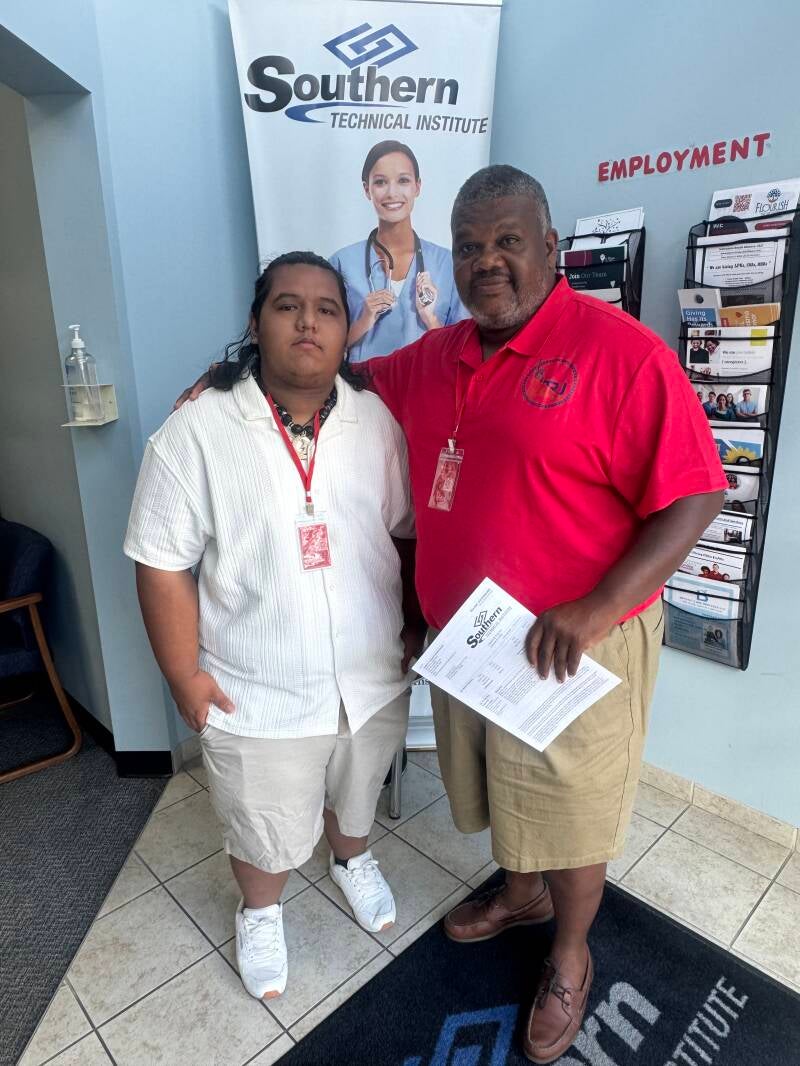
FROM PROMISE TO PURPOSE: DDRU’S “EACH ONE TEACH ONE” PROGRAM PUTS ANOTHER YOUNG MAN ON THE ROAD TO A HEALTHCARE CAREER
DDRU President Mr. Bass Continues Investing in the Next Generation Through CNA Education at Southern Technical Institute in Orlando
ORLANDO, FLORIDA — October 13, 2026
One young man. One opportunity. One more step toward a brighter future.
The DDRU of America Nursing Union is proud to announce another important milestone in its “Each One Teach One” initiative. Today, one of the young men sponsored by DDRU President Mr. YBass officially began his Certified Nursing Assistant (CNA) training at Southern Technical Institute in Orlando, Florida.
For Mr. Bass, this moment represents much more than the beginning of a training program. It represents a commitment to giving young people an opportunity to build careers, develop valuable skills, achieve greater financial independence, and discover the difference they can make in the lives of others.
Through DDRU’s education and mentorship initiative, the union is working to turn encouragement into action by helping young adults take meaningful steps toward careers in healthcare.
“WE CAN’T JUST TALK ABOUT HELPING OUR YOUNG PEOPLE — WE HAVE TO BE ABOUT IT!”
President Bass believes that young people deserve more than advice about succeeding in life. They deserve opportunities, guidance, support, and people who are willing to invest in their potential.
That belief is at the heart of DDRU’s “Each One Teach One” program.
By sponsoring young adults pursuing CNA and Home Health Aide (HHA) training, DDRU is helping open doors to careers that can provide valuable experience, professional development, and opportunities for continued education.
The union understands that the road to success is not always easy. Financial challenges, limited opportunities, and a lack of mentorship can prevent talented young people from pursuing their goals. DDRU wants to help change that reality by connecting the next generation with educational opportunities and a pathway toward a meaningful profession.
BUILDING THE NEXT GENERATION OF HEALTHCARE PROFESSIONALS
The CNA profession is an essential part of America’s healthcare system. Certified Nursing Assistants provide hands-on support to patients and residents, assist with daily living activities, and help individuals maintain comfort, dignity, and quality of life.
By helping young adults enter this profession, DDRU is investing in both individual futures and the communities that need compassionate, dedicated healthcare workers.
But the vision does not stop at CNA school.
DDRU wants these young men and women to recognize that their first healthcare credential can be the beginning of a much larger journey. With continued education, dedication, and mentorship, they can explore additional certifications, advanced healthcare training, and other opportunities as they become available.
The mission is not simply to help a young person find a job. The mission is to help that young person build a future.
A UNION THAT BELIEVES IN GIVING BACK
DDRU of America is dedicated to advocating for Certified Nursing Assistants, Home Health Aides, Nursing Assistants, and Medical Assistants. Its mission includes fighting for improved wages, workplace protections, benefits, professional recognition, and better opportunities for healthcare support professionals.
President Bass believes that advocating for workers must go hand in hand with investing in the next generation of workers.
As DDRU continues its efforts to advance its proposed $35-per-hour starting-wage initiative for direct-care workers, the union is also taking action to help young people enter the healthcare workforce.
These efforts reflect a broader vision: a future in which healthcare workers are valued for their contributions and young people have meaningful opportunities to enter the profession.
“EACH ONE TEACH ONE” — THE WORK CONTINUES
Today’s milestone follows DDRU’s earlier efforts to sponsor young adults pursuing healthcare education in Orlando. With another student now beginning CNA school, the program continues to demonstrate the importance of turning community support into tangible opportunities.
President Bass hopes that each young person who receives assistance will eventually reach back and help someone else.
Once these students establish themselves in their careers and become more secure in their futures, DDRU encourages them to help another young person take that same first step.
That is how opportunity grows. That is how mentorship becomes a movement. And that is how communities become stronger.
The philosophy is simple: when someone helps you get ahead, do not forget to reach back and help someone else.
A MESSAGE FROM DDRU PRESIDENT Mr. BASS
“I believe in our young people, and I believe we have a responsibility to help them see what is possible for their lives. We cannot keep talking about the challenges facing our communities without doing something to create opportunities.
“That is why I am committed to helping young men and women get into CNA and HHA programs and begin building careers in healthcare. I want them to know that somebody believes in them, somebody is willing to invest in them, and somebody wants to see them succeed.
“My hope is that these young people will finish their training, grow in their profession, continue their education, and one day reach back to help another young person. That is what ‘Each One Teach One’ means to me.
“We cannot just talk about change. We have to be the change. When we invest in our people, we invest in our families, our communities, and the future of healthcare.”
THE FUTURE STARTS WITH ONE OPPORTUNITY
As another young man begins his CNA education at Southern Technical Institute in Orlando, DDRU of America celebrates the possibilities ahead of him and the power of investing in people before they have the resources to invest in themselves.
For DDRU, this is not the finish line. It is another beginning.
One student can inspire another. One opportunity can change a family’s future. And one act of support can create a ripple effect that reaches far beyond the classroom.
DDRU of America — advocating for healthcare workers, investing in young people, and building a stronger future through education, opportunity, and service.
“Each One Teach One. We can’t just talk about it. We have to be
Respectfully
DDRU of America Nursing Union
Website: www.DDRU.org
Email: admin@ddru.org
Phone: (904) 689-4031
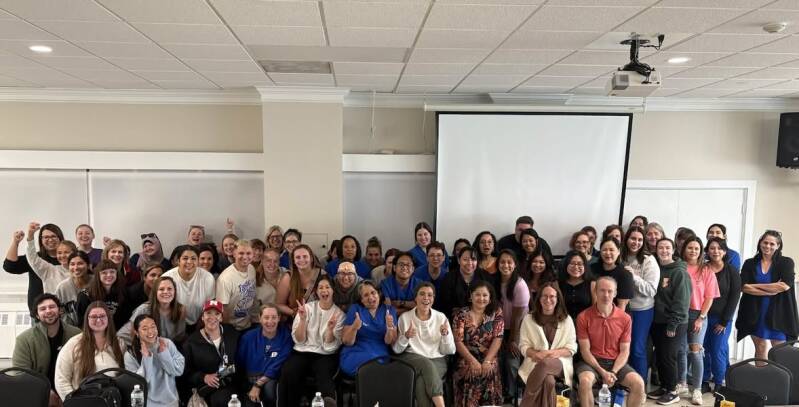
THEY CARE FOR AMERICA — WHO IS FIGHTING FOR THEM? DDRU of America • The $35-an-hour wage campaign America's CNAs and HHAs are demanding better wages, stronger benefits, and the respect they deserve.
THE HEALTHCARE WORKERS WHO CARE FOR AMERICA DESERVE MORE! DDRU OF AMERICA FIGHTS FOR $35 AN HOUR — BUT CNA & HHA WORKERS MUST STAND TOGETHER!
1,000+ nurses at Edward Hospital just filed to unionize with NNU/NNOC ! This is a major step for our Affiliates and now DDRU of America is Calling on Certified Nursing Assistants, Home Health Aides, Nursing Assistants, and Medical Assistants to Unite for Better Wages, Stronger Benefits, and the Respect They Deserve.
ST. AUGUSTINE, FLORIDA — The fight for fair wages in America's healthcare industry is heating up, and DDRU of America is sending a powerful message to the nation: The workers who care for our seniors, assist our patients, and help keep our healthcare system moving deserve more than applause. They deserve better pay, meaningful benefits, workplace protections, and a voice in the decisions that affect their lives.
For far too long, Certified Nursing Assistants (CNAs), Home Health Aides (HHAs), Nursing Assistants (NAs), and Medical Assistants (MAs) have carried enormous responsibilities while struggling to receive the financial recognition and workplace respect their essential work deserves.
Now, DDRU of America is turning that frustration into a fight for change.
THE $35-AN-HOUR FIGHT: A NEW CHAPTER FOR DIRECT-CARE WORKERS
DDRU of America is advancing its proposed Florida Direct Care Healthcare Workforce Wage Act, an initiative calling for a $35-per-hour starting wage for CNAs, NAs, and HHAs.
The proposal reflects a fundamental belief: caring for another human being is skilled, demanding, and essential work. Workers should not have to choose between supporting their own families and continuing to provide compassionate care to someone else's. CNA'S and HHA'S have to pay attention to RN'S as they stick together, join,support their union and fight through collective bargaining for better pay, benefits, and the best work enviorment and pateint care. DDRU's president stated
The $35 starting-wage proposal is an advocacy goal—not a wage law currently in effect. Turning it into law will require legislative action, support from policymakers, and a united movement of healthcare workers and community allies.
DDRU is calling on direct-care workers throughout Florida to make their voices heard, support the proposal, and encourage lawmakers to take this issue seriously.
The question is no longer whether direct-care workers deserve better. The question is whether America is ready to do something about it.
WHY JOIN DDRU? BECAUSE CHANGE REQUIRES A UNITED VOICE.
DDRU of America was established to focus on the needs of the healthcare support professionals who are too often overlooked in conversations about healthcare wages, benefits, staffing, and professional advancement.
Unlike traditional nursing organizations that may concentrate on other segments of the profession, DDRU centers its mission on advocating for CNAs, HHAs, NAs, and MAs.
The union's approach is built around three powerful principles:
INVESTIGATE. LITIGATE. LEGISLATE.
From investigating workplace concerns and pursuing appropriate legal remedies to advocating for better laws and stronger labor protections, DDRU is working to make the voices of direct-care workers count.
DDRU's mission is to fight for:
Better wages: Advocate for fair starting pay and stronger compensation standards.
Better benefits: Push for meaningful employment benefits and greater financial security.
Workplace protections: Help workers understand their rights and address unfair treatment through appropriate channels.
Professional recognition: Ensure that CNAs, HHAs, NAs, and MAs are included in conversations about the future of healthcare.
Career opportunities: Connect members with employment information, professional development, and advancement opportunities.
Legislative change: Build public and political support for policies that improve the lives of direct-care workers.
THE WORKERS WHO CARE FOR EVERYONE NEED SOMEONE FIGHTING FOR THEM.
Every day, CNAs and HHAs assist people with some of life's most personal needs. They help patients bathe, dress, eat, move safely, and maintain dignity. They provide companionship, observe changes in condition, and support families during some of their most difficult moments.
These responsibilities demand patience, compassion, physical effort, and dedication.
Yet many direct-care workers face rising living costs, limited benefits, exhausting schedules, and uncertainty about their financial futures.
DDRU believes this reality must change.
A healthcare system that depends on direct-care workers cannot afford to keep treating their economic security as an afterthought.
When experienced workers cannot afford to remain in the profession, employers may struggle to retain staff, families may face disruptions in care, and patients may suffer the consequences of workforce instability.
Fair compensation is not simply a paycheck issue. It is part of the larger conversation about workforce stability, quality care, and the future of America's healthcare system.
THIS MOVEMENT NEEDS MORE THAN SUPPORTERS. IT NEEDS MEMBERS.
DDRU is calling on every CNA, HHA, NA, and MA who believes in fair wages and professional respect to consider becoming an active part of the movement.
Workers can share their experiences, encourage colleagues to get involved, support legislative initiatives, and help bring greater public attention to the challenges facing direct-care professionals.
The strength of a labor movement depends on participation, organization, and sustained action. The more workers engage in the conversation, the harder it becomes for decision-makers to ignore their concerns.
DDRU is asking direct-care workers to stop watching the fight from the sidelines and help shape the future of their profession.
If you believe CNAs and HHAs deserve better wages, if you believe healthcare support workers deserve meaningful benefits, and if you believe the people who care for our families deserve to support their own families, this movement is calling for your voice.
PRESIDENT BASS: “WE CAN'T TALK ABOUT IT. WE HAVE TO BE ABOUT IT.”
DDRU's leadership has emphasized that improving the lives of healthcare support professionals requires more than speeches and promises. It requires organizing, legislative advocacy, partnerships, and tangible opportunities for workers and the next generation.
Under President Bass leadership, DDRU has also promoted educational opportunities for young adults entering the healthcare workforce through its “Each One Teach One” initiative.
The organization's broader vision is to connect worker advocacy with career development, employment opportunities, and stronger economic prospects for direct-care professionals.
For DDRU, the fight for better wages is about more than a number on a paycheck. It is about dignity, opportunity, stability, and ensuring that the next generation of caregivers can build a future in healthcare without being left behind.
FLORIDA, THE NEXT MOVE IS YOURS.
DDRU is urging CNAs, HHAs, NAs, MAs, families, healthcare advocates, and community leaders to support a serious public conversation about direct-care wages and workplace conditions.
The union is encouraging workers to visit its official website, review the legislative draft, and express their support for the proposed $35 Wage Act.
Visit: www.DDRU.org
Look for the “DDRU Legislative Draft” tab and the “$35 Wage Act” initiative to learn more and add your voice to the campaign.
Workers are also encouraged to explore DDRU membership and learn how they can participate in the organization's advocacy and professional development efforts.
THE BOTTOM LINE: THE PEOPLE WHO CARE FOR AMERICA DESERVE TO BE CARED FOR, TOO.
The fight for better wages will not be won overnight. Legislative change takes persistence. Building a stronger workforce takes cooperation. And lasting progress requires workers to make their voices heard.
DDRU of America is continuing to push for a future in which direct-care professionals receive stronger compensation, better benefits, meaningful protections, and the respect their work demands.
A $35 starting wage is the goal. Unity is the strategy. Better lives for direct-care workers are the mission.
DDRU OF AMERICA
Florida's First Union Dedicated to Certified Nursing Assistants, Home Health Aides, Nursing Assistants & Medical Assistants
Website: www.DDRU.org
Email: admin@ddru.org
Phone: (904) 689-4031
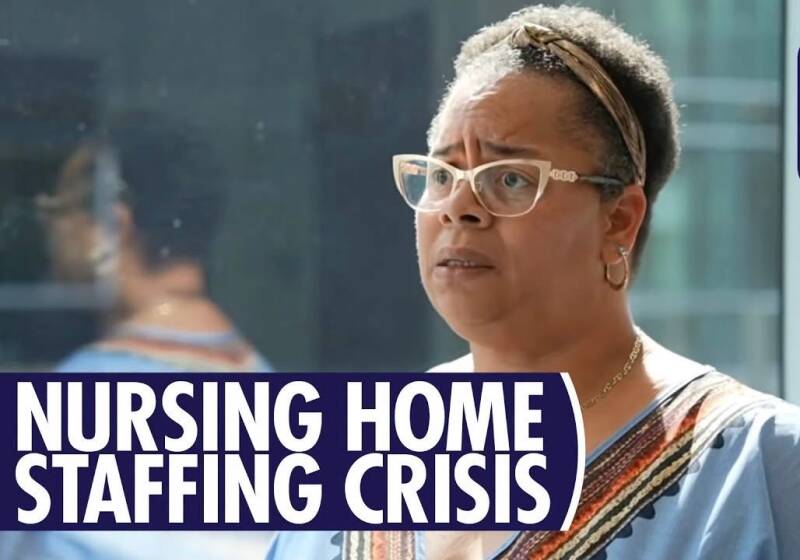
DDRU is investigating, CNA's calling for safer ratios in RICHMOND, Va nursing homes:
October 4, 2026
Frustrated families of nursing home residents demanding more action from state leaders as they say their loved ones are receiving poor care and being mistreated in facilities.
Several attended the state's Nursing Home Oversight Advisory Panel on Wednesday to give testimony about what their loved ones have experienced, including two sisters who pleaded for help regarding their mother's care.
"These people that are vulnerable and can't speak for themselves need some help. They don't just need you to talk about it," the sisters said.
Another speaker, Leticia Edwards, said it's a "constant battle" ensuring her mother is being properly changed and hydrated. She said she hired a personal aide when she was unable to visit her mother's facility just to make sure she received basic care.
“There's one CNA (certified nursing assistant) to a whole ward. That don't even sound legal," Edwards said during public comment.
One CNA who attended the meeting, Tomeka Coley, said she used to work in nursing homes but became burnt out and quit.
She cited staff-to-patient ratios that she believed were unmanageable.
“It's nowhere near adequate. If you have 14 to 30 patients, how do you take care of them?” Coley said.
She added she was in disbelief that Virginia does not have a minimum staffing standard.
“In a nursing home, they can't do anything for themselves. So why would you have no ratio?" Coley said. "They need to get on board with that, like ten years ago.”
Virginia ranks only above four other states in the country when it comes to federal staffing ratings— scores that are based on nursing homes' rates of turnover and levels of staffing.
The Virginia Department of Health's own inspections have documented multiple instances of patient harms and reports of employees stretched beyond their limits due to inadequate staffing.
“Does the Spanberger administration support an enforceable, defined state staffing standard in Virginia?” A reporter asked.
“That's a conversation we're gonna have with the General Assembly. I also think you heard earlier today about how we're gonna use our payment and our tools that we have right now to be able to encourage improved staffing. I also just had a conversation with my agencies as well to see how we could do better partnerships to increase the workforce," Figueroa answered.
Health and Human Resources Secretary Marvin Figueroa
“To be clear, though, does the governor have a position on an enforceable staffing standard?” Layne asked.
“It is an important thing that we need to address. I can't give you a specific here 'yes' or 'no' because a lot goes into that policy, but definitely something we're exploring," Figueroa said.
When asked whether she supported a staffing standard, a spokesperson for Governor Spanberger's Office did not directly answer the question but said in an email that the governor "looks forward to taking additional steps together with the General Assembly to make sure every Virginian knows their loved one is being treated with dignity and respect.”
April Payne with the Virginia Health Care Association (VHCA), a trade group that represents nearly every nursing home in the state, said in a presentation to the panel Wednesday that the "staffing crisis" is the number one challenge facing providers.
However, she said low staffing does not always equate to poor quality.
“I’m not going to be able to draw that direct correlation because there are some facilities that, well, they make it happen, and there hasn't been an impact to quality of care," Payne said.
Payne added emerging concerns the VHCA has identified surround ensuring licensed staff are competently trained and addressing a rise in nursing home patients with mental health or substance abuse disorders.
Secretary Figueroa said another industry group, Virginians Advocating for Seniors, was also invited to present to the panel.
But that presentation, which was featured on the meeting agenda, didn't happen.
“I think the conversation we wanted to have was about quality, and they're an important partner to make sure that we're increasing quality, and it's telling that they weren't here," Figueroa said.
A spokesperson for Virginians Advocating for Seniors said its presenter Chanta Combs was unable to make it to the meeting due to "travel complications."
The spokesperson shared with CBS 6 a slideshow that Combs would have presented to the panel. The presentation included federal data showing Virginia outperforms most other states on specific quality measures. Quality measures are scored based on data that nursing facilities report to the Centers for Medicare and Medicaid Services (CMS). The data includes resident outcomes such as rates of urinary tract infections, falls, and hospitalizations.
Quality measures are one of three components that make up a nursing home's overall quality rating, as scored by CMS. The other two components are health inspection outcomes and staffing measures. The slideshow did not mention that Virginia's average health inspection and staffing scores are below the national average.
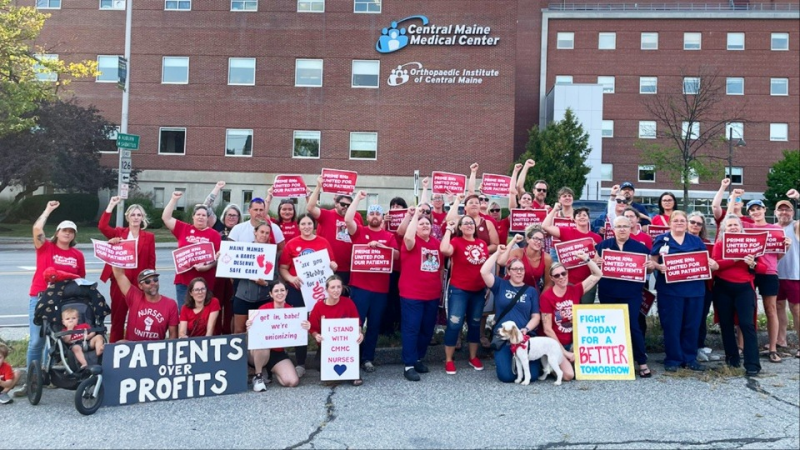
DDRU stands firm with our certified nursing assistants and registered nurses at Central Maine Medical Center
Sentinel Free press
- October 2,2026
DDRU stands firm with our certified nursing assistants and registered nurses at Central Maine Medical Center (CMMC) whom voted overwhelmingly to join the State Nurses Association/National Nurses Organizing Committee (MSNA/NNOC).
They voted 91% yes (204-21). A day earlier, nurses at Olympia Fields Hospital in Illinois joined as well. NNOC is an affiliate of DDRU OF AMERICA and National Nurses United (NNU), the largest and fastest-growing nursing union in the nation.
“We are beyond thrilled to win our union election. Prime Healthcare thought they could silence us,” said Aaron McDaniel, RN, an intensive care unit nurse at CMMC.
“But now we are members of the National Nurses Organizing Committee, and we will use our voices to speak up loudly for our patients. We’re so proud to join NNOC because we know we will win a contract that will make a drastic difference for our patients and for us as nurses to build a healthier community.”
Nurses at the 250-bed facility say they voted to join the union because it is critical that “nurses have a say in making decisions that affect patient care, working conditions, staffing, and recruitment and retention of experienced nurses.”
With their election victory, nurses will continue to demand better benefits and higher wages. The CNA”s and Nurses at Olympia Fields Hospital voted 82% in favor of joining. “We are so proud to win our union election. We fought hard for this victory because we want to give our patients the best care,” said Darlene Estrada-Smith, a nurse in the outpatient surgery unit.
“Nurses wanted to join the National Nurses Organizing Committee because we know that organizing and forming a union is how we can best advocate for ourselves and patients. We look forward to building a strong contract that protects nurses and patients.”
Nurses at Olympia Fields continue to speak up and fight for their patients. The facility is also owned by Prime Healthcare.

Thank you for your support and interest in DDRU. We encourage you to explore our website, and join our movement.
DDRU - Oct 1, 2026
Thank you for your support and interest in DDRU. We encourage you to explore our website, and join our movement. Please let us know how we can be a benefit and help to you. We can not be heard if its only our Administration passing the word along, fighting for better pay and benefits for CNA"s and HHA's. Our founder started DDRU to help CNA's and HHA's, Receive the wages and benefits they deserve. Along the way we have built bonds and strong relationships with multiple nursing cordinators, Healthcare facilities and travel nurse agencies as well as Cruise ship medical staffing cordinators that keep Our members working. Our union is not limited to one facility or ran by the hospital or facility you work for. We are a self sustained union that represents CNA's, HHA's, NA''s and other healthcare workers at different facilities across America... We all come together through collective bargaining to fight for our Rights, Wages and benefits. Thus, let us be clear, if you are the only DDRU member working at a facility thats mistreating you, underpaying you, or they're making you perform work duties thats above your pay grade, DDRU Staff and members will show up, and adress the matter Swiftly and professionaly on your behalf. Next step, We will inform our Legal department to persue pre-Litigation. We look forward to representing you and having you as a future member of DDRU of America.
Respectfully,
DDRU Admin.

DDRU OF AMERICA is becoming Florida’s Top rated union, keeping healthcare facilities staffed, and union members working
The weekly news (TWN )
- September 30, 2026
DDRU Assign CNA jobs that are right for you
Healthcare facilities rely on travelers for many reasons, including low-staffed units in need, strikes, crisis help and more. That means certified nursing assistants (CNA’s) have multiple of job options. At Www.DDRU.org click on “ NOW HIRING” tab, and find many different CNA job assignments to choose from.
When you’re searching CNA jobs, it’s good to remember that CNA openings fills very fast. The best way to land your dream assignment is to be up to date on your resume and follow the submission guidelines on our website. Remember that your résumé should lists your skill sets and areas of interest. The more you tell us about you, the better we can cater the assignments options we present to your needs.
CNA Salary – Travel vs Local Per Diem
A CNA salary varies from facility to facility, but DDRU offers competitive Union wages for CNA contracts nationwide. Most of our CNA jobs are travel as well as high paying local assignments that benefits our members and affiliates.
Certified Nurse Assistant Job Frequently Asked Questions
What are the requirements for a travel assignment?
To land a travel CNA job with DDRU, you simply become a DDRU member, submit your résumé and include a copy of your BLS and CNA license to meet our requirements:
What finances should I take into consideration?
For most CNA assignments, you’ll make an hourly wage between $20-$25 and some crisis contracts offering $30- $45 an Hour.
What gives me an advantage when applying for CNA jobs through DDRU OF AMERICA.
It’s simple we are your union and we are here to protect you and keep you working with jobs that pay the highest wages and offer the best benefits. Through collective bargaining, we always negotiate on your behalf, and the best value Interest of our members.
When will I be contacted about a job …
Once you go to ddru.org, submit your résumé and become a member, our admin will contact you as soon as possible. DDRU Admin reaches out to the members that best fit the job requirements, based on a variety of factors including experience, location, references, skills and interest. To ensure the best chance of securing an assignment quickly, submit your updated resume, BLS, CNA license, and other documents via email……
Email: admin@ddru.org
Website: www.DDRU.org
Phone: +1 (904) 689-4031
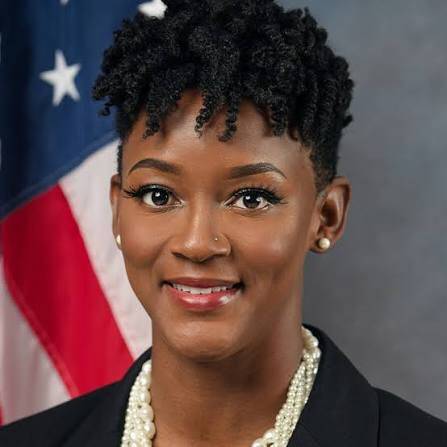
DDRU endorses Angie Nixon to represent Florida in the U.S. Senate
El Nuevo Herald
- September 28,2026
DDRU OF AMERICA the largest union of Certified nursing assistants (CNA), HHA’s and NA’s in the United States with more than 5,000 affiliates & strong members, today announced its endorsement of Angie Nixon from Florida for the U.S. Senate. If elected, Nixon will join nurses in our fight to take on the billionaire class and deliver for workers, and guarantee comprehensive health care through Medicare for All.
“Angie Nixon is a proven fighter, and the leader Floridians deserve.” “In her role as state representative and union organizer, Angie took on corrupt billionaires and corporate-backed politicians to deliver strong workplace protections, access to healthy food, and affordable childcare. Nurses are ready to get to work to elect Angie so that together we can fight for progressive policy wins that will transform our health care system and build an economy that benefits all working people.”
“I am honored to earn the support of National Nurses United, a union that has been on the front lines of the fight for bold, progressive change,” said Angie Nixon. “Our nurses experience every day the failings of a health care system that puts profit over patients. Together with NNU, we will pass Medicare for All, and take on the billionaire class.”
DDRU & NNU supports candidates who are committed to nurses’ values, including safe patient staffing in all hospitals across the country, protecting the rights of workers to organize, and guaranteeing health care to everyone. In a recent Gallup poll, nurses were voted the most trusted profession in the United States for the 24th consecutive year. DDRU looks forward to helping elect Angie Nixon and working closely with her in Congress on the important issues that affect Healthcare workers, our patients, and our communities.

DDRU’S $35 WAGE PROPOSAL CONFERENCE DRAWS MORE THAN 500 MEMBERS AND AFFILIATES TO MIAMI
DDRU President Mr Bass Calls for Unity Among CNAs, Home Health Aides, and Nursing Assistants in the Fight for Higher Wages
DORAL, FLORIDA - September 25
A Historic Gathering Focused on Fair Pay and Recognition for Healthcare Support Professionals
The Intercontinental Miami in Doral, Florida, served as the meeting place for a major gathering of healthcare professionals as DDRU of America presented its proposed $35-per-hour wage initiative for Certified Nursing Assistants (CNAs), Home Health Aides (HHAs), and Nursing Assistants (NAs).
More than 500 members and affiliates reportedly attended the conference, representing organizations and associations connected to the Black Nurses Association, National Nurses Association, Florida CNA associations, and home health aide associations.
The conference brought together healthcare professionals, organizational affiliates, and advocates around a shared discussion of wages, working conditions, and the economic challenges facing the direct-care workforce.
President Bass Introduces DDRU’s $35 Wage Proposal
During the conference, DDRU President and Founder David Allen Bass Sr. introduced the union’s proposed $35-per-hour wage initiative to members and affiliates.
The proposal reflects DDRU’s stated commitment to improving compensation for the healthcare professionals who provide essential hands-on care to patients, seniors, and individuals who depend on assistance in their daily lives.
President Bass highlighted the importance of building relationships with Florida lawmakers, including state senators and members of the Florida House of Representatives, as DDRU continues its legislative efforts.
For DDRU, the conference represented an opportunity to bring its wage proposal before a broad audience of healthcare professionals and strengthen the discussion surrounding fair compensation for direct-care workers.
Building Legislative Support Across Florida
DDRU has identified legislative engagement as a central part of its efforts to advance the $35 Wage Act proposal.
The organization has been pursuing support from Florida legislators as it works to move its proposal forward. The conference provided a platform for President Bass to discuss that legislative outreach and encourage continued participation from the organizations and individuals represented.
While introducing a wage proposal is an important step, advancing legislation requires continued engagement, consideration by lawmakers, and work toward addressing the funding and implementation questions associated with higher wages.
DDRU’s stated objective is to keep the needs of CNAs, HHAs, and NAs at the center of that conversation.
President Bass: The Journey Must Continue
President Bass emphasized that the work cannot stop with one conference.
The turnout of more than 500 members and affiliates demonstrated the level of participation DDRU reported at the gathering. The organization now intends to continue building its coalition and expanding awareness of the proposed $35 wage initiative.
DDRU is calling on CNAs, HHAs, and NAs throughout Florida to learn about the proposal, connect with the union, and consider participating in the movement for higher wages and improved working conditions.
A Call to Florida’s CNA and Home Health Aide Workforce
DDRU of America is encouraging direct-care professionals to visit www.DDRU.org and look for the “DDRU Legislative Draft” section to learn more about the proposed $35 Wage Act.
Those who support further consideration of the proposal can follow the instructions provided on the website to register their interest and demonstrate support for the initiative.
The organization’s message is that the voices of the people who provide direct care should be included in conversations about their wages, professional recognition, and future.
The conference may have brought hundreds of healthcare professionals together in Doral, but DDRU says the broader effort continues across Florida.
For President David Allen Bass Sr. and DDRU of America, the next phase is focused on expanding participation, continuing legislative outreach, and keeping the proposed $35 wage initiative in the public conversation.
About DDRU of America
DDRU of America is a labor organization focused on advocating for Certified Nursing Assistants, Home Health Aides, Nursing Assistants, and Medical Assistants. Its stated priorities include higher wages, workplace protections, professional recognition, educational opportunities, and improved benefits for healthcare support professionals.
Learn more: www.DDRU.org
Email: admin@ddru.org
Phone: (904) 689-4031
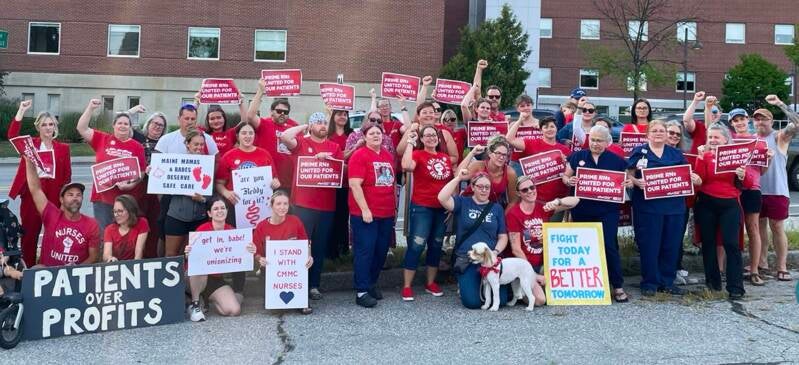
DDRU Stands in Solidarity With National Nurses United in Defense of Patient Advocacy
— DDRU reports sept 23, 2026
DDRU Stands in Solidarity With National Nurses United in Defense of Patient Advocacy
DDRU of America CNA/HHA Union is expressing solidarity with National Nurses United and nurses who are advocating for patient safety, quality care, and fair treatment in the workplace amid allegations that Prime Healthcare has suspended or terminated nurses for speaking up on behalf of their patients.
According to National Nurses United, approximately 20 nurses have been suspended or fired after raising concerns related to patient care. The union is calling on Prime Healthcare executives to reinstate the affected nurses and respect the rights of healthcare professionals to advocate for their patients without fear of retaliation.
National Nurses United has also raised broader concerns about Prime Healthcare’s alleged decisions to reduce or eliminate services that communities depend on. The organization argues that placing profits above patient care can endanger both patients and healthcare workers.
In response, DDRU of America CNA/HHA Union President David Allen Bass issued a statement reaffirming the organization’s support for nurses and other frontline healthcare professionals.
“DDRU stands in solidarity with nurses who are advocating for their patients, safe patient care, and a fair and respectful workplace,” Bass stated.
DDRU represents Certified Nursing Assistants, Home Health Aides, Nursing Assistants, and Medical Assistants. The union emphasized that quality healthcare depends on workers being able to raise legitimate concerns when they believe patient safety or the quality of care may be at risk.
“Our healthcare system is strongest when nurses and other healthcare professionals can raise legitimate concerns without fear of retaliation,” DDRU stated. “Patient advocacy is an important responsibility shared across the healthcare workforce, and the voices of frontline healthcare workers deserve to be heard and taken seriously.”
DDRU further affirmed its support for nurses’ right to advocate for their patients and for efforts to ensure that healthcare workers are treated fairly and with dignity.
“DDRU believes that when healthcare workers stand together, our patients and our communities benefit,” the organization stated.
National Nurses United is urging supporters to contact Prime Healthcare executives and demand the reinstatement of nurses who were suspended or terminated. The organization maintains that safe patient care depends on healthcare professionals having the freedom to speak up in the best interests of their patients.
DDRU said it will continue standing with healthcare professionals who work to improve patient care, workplace conditions, and the future of the healthcare workforce.
“In solidarity,”
David Allen Bass
President
DDRU of America CNA/HHA Union
DDRU.org

First Two Young Adults Begin Healthcare Career Journey as DDRU Sponsorship Program Takes Shape in Palatka fl.
DDRU’S “EACH ONE, TEACH ONE” INITIATIVE MOVES FROM PROMISE TO ACTION
First Two Young Adults Begin Healthcare Career Journey as DDRU Sponsorship Program Takes Shape in Palatka fl.
ORLANDO, FL — September 22, 2026 — Just weeks after announcing that DDRU of America President Mr. Bass would sponsor three young adults pursuing careers in healthcare, DDRU is now turning that commitment into action.
Today, the first two young adults participating in DDRU’s educational initiative took another important step toward their healthcare careers as they prepared to begin their training in Orlando. Today they completed their Basic Life Support (BLS) , an important requirement for many healthcare education and employment pathways. Next week they start Southern Technical Institute in Orlando, Florida, where they will pursue education and training to become Certified Nursing Assistants (CNAs
The initiative is part of President Bass’s “Each One, Teach One” philosophy: provide young people with an opportunity to enter the healthcare profession, help them establish career security, and encourage them to eventually help another young person do the same.
FROM THE STREETS TO A CAREER PATH
For DDRU, this program is about more than paying for school.
It is about creating an alternative path for young adults who may be trying to determine what direction their lives should take.
Through its sponsorship initiative, DDRU is helping young people pursue education and professional training while introducing them to the healthcare workforce and the opportunities available in careers such as Certified Nursing Assistant (CNA) and Home Health Aide (HHA) work.
The organization says the goal is simple: education, career preparation, mentorship and opportunity.
THE FIRST TWO ARE NOW ON THEIR WAY
The first two sponsored students are now beginning the process that DDRU hopes will lead them toward meaningful healthcare careers.
For President Bass, seeing the program begin with real students is significant.
" We can’t just talk about changing young people’s lives. We have to be willing to invest in them,” Bass said. “If we give someone an opportunity to get an education, build a career and become successful, then that person can turn around and open the door for someone else.”
That philosophy is the foundation of DDRU’s “Each One, Teach One” initiative.
ONE OPPORTUNITY CAN CREATE ANOTHER
The program is designed around a cycle.
DDRU invests in a young person.
That young person builds a career.
That career creates stability.
Then that person helps another young person.
The ultimate objective is to create a continuing pipeline of trained healthcare workers while giving young adults an opportunity to build their futures through education.
DDRU says it wants the initiative to become bigger than the original three students.
The organization envisions a future where additional young adults receive assistance with healthcare education and training, creating what DDRU describes as a community-to-career pipeline.
HEALTHCARE NEEDS THE NEXT GENERATION
Healthcare depends on a strong workforce at every level.
CNAs, HHAs and other healthcare support professionals provide essential services to patients, seniors, people with disabilities and families throughout communities.
DDRU’s educational initiative is intended to introduce more young people to these career opportunities while emphasizing the importance of training, professionalism and patient care.
The organization says its message to young people is:
Your circumstances today do not have to determine your future tomorrow.
“WE’RE JUST GETTING STARTED”
The first two students are only the beginning of what DDRU hopes will become a continuing educational initiative.
As they move forward with their training, DDRU plans to continue supporting their development and encouraging them to think beyond their own success.
The goal is eventually for each participant to become an example for someone else.
That is the meaning behind “Each One, Teach One.”
President Bass has repeatedly emphasized that communities cannot simply ask young people to change their lives without helping provide the tools necessary to make that change possible.
Now, with the first two sponsored students moving forward in Orlando, DDRU is beginning to demonstrate what that commitment looks like in practice.
Two young adults.
One opportunity.
A healthcare career ahead.
And DDRU says there are more young people waiting for their opportunity.
DDRU OF AMERICA
Nursing Union • Education • Mentorship • Opportunity
“Invest in yourself. Inspire others. Build stronger communities.”
The future is in our hands.
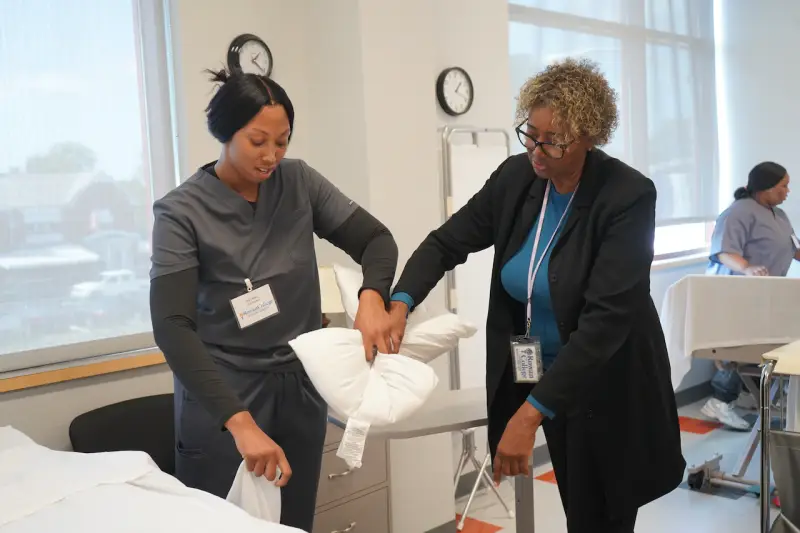
N.J. needs 4,000 more nursing assistants. This pilot program is a start.
DDRU Reports
- September 18,2026
Aliya Baker had been searching for an affordable way to begin a nursing career.
The 22-year-old Vineland resident explored two health care training programs, but both required students to pay the full cost before starting. One charged nearly twice as much as Rowan College of South Jersey, she said.
Baker, who works as a direct support professional, continued looking. When she saw information about a Rowan program for unemployed workers, she attended a seminar even though she already had a job. An employee encouraged working students to visit the college’s workforce office to learn about other possibilities.
“I went to that office, and I was like, ‘What do you have available?’” Baker said.
Her persistence led her to the CNA Accelerator Program, a new partnership between Clipboard and the New Jersey Community College Consortium for Workforce and Economic Development.
The pilot is covering tuition, course materials and examination fees for Baker and 23 other students pursuing Certified Nurse Aide credentials through Rowan College of South Jersey, Essex County College and Mercer County Community College.
The program connects two sides of a difficult labor market. New Jersey is projected to be short approximately 4,000 nursing assistants by 2028, while young people — particularly some young people of color — continue to face higher barriers to employment.
Nationally, the July unemployment rate among people ages 16 to 24 was 12% for Black youth and 11% for Asian youth, compared with 8.3% for white youth and 8.9% for Hispanic youth, according to the U.S. Bureau of Labor Statistics.
The CNA program offers participants an opportunity to enter an understaffed field without assuming education-related debt for their training.
A Mercer labor-market analysis projects that New Jersey will face an overall deficit of nearly 17,800 health care workers by 2028, the second-largest projected shortage in the country behind New York. Nationally, the shortage of nursing assistants is expected to exceed 73,000, with only 13 states projected to meet or surpass demand.
Nursing assistants provide direct care in nursing homes and other health care facilities, helping patients with daily activities and closely monitoring changes in their physical and emotional condition.
Clipboard is an online marketplace that connects health care facilities with nurses, nursing assistants and other professionals who are available to fill open shifts.
Founder and co-CEO Wei Deng said the company approached the Council of County Colleges about helping more people qualify for health care careers.
“We know that the biggest hurdle for many aspiring health care professionals is simply getting a foot in the door,” Deng said.
The consortium is administering the initiative, while the individual colleges recruited and selected the students.
Aaron Fichtner, president of the New Jersey Council of County Colleges, said the colleges considered applicants’ financial need, interest in health care and commitment to completing the program.
The council coordinates New Jersey’s 18 community colleges, while its workforce consortium helps colleges develop education and training programs aligned with employers’ needs.
“We hope that this will be the beginning of a longer and broader partnership with Clipboard and maybe other interested organizations that might join with us,” Fichtner said. “These public-private partnerships are really, I think, the way of the future.”
The 24-student pilot is small compared with the projected statewide shortage. Fichtner described it as a first step that could provide a model for other companies and organizations interested in supporting workforce training.
Deng said Clipboard began with a limited number of students so the company and colleges could learn from the pilot before considering an expansion.
Although Clipboard could benefit from increasing the number of qualified health care workers, graduates are not required to accept jobs through its marketplace, Deng said.
“Success will come if they go on to a job in the field. Period,” she said. “And it doesn’t have to come through us.”
Deng obtained her own CNA credential about two years ago because she wanted to understand the experiences of the professionals using Clipboard’s platform. She completed clinical training and worked shifts alongside nursing assistants.
"It’s a very difficult job,” she said.
Deng said CNAs do more than help residents with their physical needs. For people in nursing homes who may not receive regular visits from relatives or friends, an aide can also provide companionship.
"You’re really bringing brightness to their day because many of these people, especially in a nursing home, may not have a loved one there that day,” she said.
Baker understands the responsibility of caring for others. In addition to working as a direct support professional, she helps care for her father, who has cancer, while raising a son who is nearly 2.
Her six-week class at Rowan includes classroom instruction and clinical experience at the New Jersey Veterans Memorial Home at Vineland. Baker said visiting the facility and meeting residents gave her an early look at the work she will perform.
Baker created a group chat with her 9 other classmates where they exchange notes, ask questions and help one another when someone misses information.
She believes CNAs occupy an especially important position because of the amount of time they spend with residents.
"We’re going to be close to the residents more than most,” Baker said. “We’re going to know what they like.”
After becoming certified, Baker plans to work in the field before returning to school. Her eventual goal is to become a registered nurse.
“I like taking care of people,” she said.
The failed first attempt at college and the cost of private training programs did not end that ambition. Baker kept asking what opportunities were available until she found one.

MedStar Franklin nurses to hold rally for patient safety
DDRU MEMBERS, LETS SUPPORT OUR NURSES IN SOLIDARITY.
-FRIDAY SEPT, 18,2026
Registered nurses at MedStar Franklin Square Medical Center, in Baltimore, Md. will hold a rally on Saturday, Sept. 19, 2026 to highlight unaddressed patient safety concerns — including short-staffing and lack of equipment and supplies — that have driven them to unionize, announced National Nurses Organizing Committee/National Nurses United (NNOC/NNU) today. The rally comes after nurses filed a petition on Sept. 10 with the National Labor Relations Board to hold union elections. That election has not been scheduled yet.
“We are compelled to form a union because we see deteriorating conditions in our hospital,” said Katie Stancil-Ervin, RN in the emergency department. “In the ER we are seeing patients held for hours without being admitted because there are not enough nurses in the units. We are seeing intensive care unit nurses taking care of three patients at a time, when they should have no more than two patients. We have broken equipment in the operating room that delays care. These chronic problems must be dealt with and MedStar has not been willing to do that. That is why we need a strong union contract to address these patient safety issues.”
Nurses note the poor staffing by MedStar Health landed Medstar Franklin Square on a list of the longest ER visits in the country for 2025. According to the Centers for Medicare and Medicaid Services (CMS) the national average for an ER visit is 162 minutes, but at MedStar Franklin the visits were 367 minutes.
Who: RNs at MedStar Franklin Square Medical Center
What: Rally for patient safety
When: Saturday, Sept. 19, 8 a.m.
Where: MedStar Franklin Square Medical Center | 9000 Franklin Square Dr., Baltimore, Md. (public sidewalk at Franklin Square Dr. and Hospital Dr.)
Nurses say they have witnessed aggressive union busting on the part of management. They note the not-for-profit hospital receives millions of dollars in tax breaks, as well as federal and state grants. According to the Federal Audit Clearinghouse, in 2025 alone MedStar Health spent $78.9 million in federal funding awards. Notably, according to their own financial records, MedStar made more than a billion dollars in 2024 and 2025.
Nurses say it is disgraceful that money that should be spent on patient care is going to pay for private consultants to attempt to silence nurses as they advocate for safe patient care.
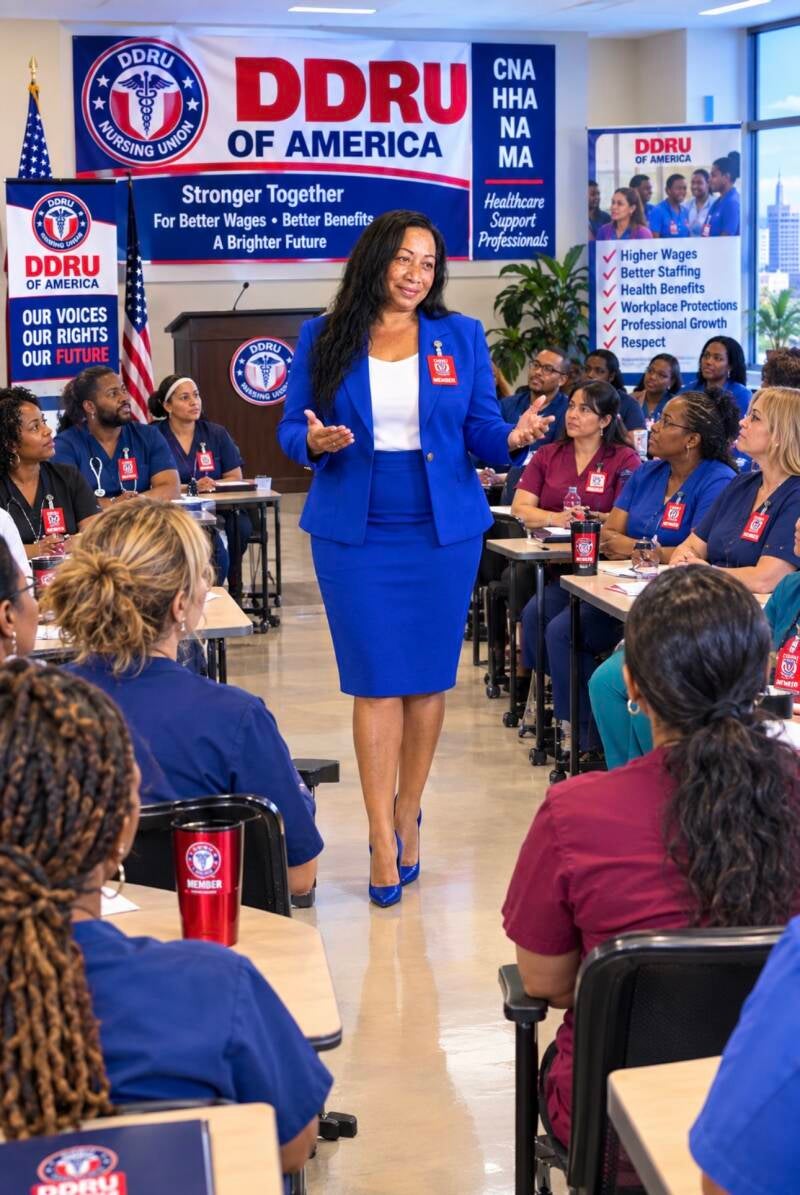
DDRU CALLS ON FLORIDA’S CNA, HHA AND NA WORKFORCE TO STAND TOGETHER FOR THE $35 WAGE ACT
Nursing Union Launches Statewide Call for Support as Legislative Outreach Begins
ST. AUGUSTINE, FL — September 15, 2026 — The DDRU Nursing Union is moving forward with its statewide effort to advance the proposed Florida Direct Care Healthcare Workforce Wage Act, a legislative proposal calling for a $35-per-hour starting wage for Certified Nursing Assistants (CNAs), Home Health Aides (HHAs), and Nursing Assistants (NAs).
DDRU’s president Mr. Bass says the next phase of the campaign is about bringing Florida’s direct-care workforce into the conversation.
As part of that effort, DDRU has sent a legislative sponsor request to Florida Senator Jennifer Bradley and Florida Representative Chase Tramont, asking them to consider helping DDRU advance the proposal through the legislative process.
Senator Bradley currently represents Florida Senate District 6, while Representative Tramont represents Florida House District 30. (Florida Senate)
“Now We Need the Workers to Speak”
Bass says contacting legislators is only one part of the process. DDRU is now asking CNA, HHA and NA professionals throughout Florida to publicly demonstrate their support for the proposed legislation.
“We have presented our proposal to lawmakers. Now we need the people who provide direct care every day to make their voices heard,” Bass said. “This is about showing that CNAs, HHAs and NAs are paying attention to the legislative process and want their voices included in discussions about wages, staffing, benefits and the future of direct-care work in Florida.”
According to the Home Care Association of Florida, national median pay for home health and personal care aides was $34,900 annually, or $16.78 per hour, in 2024. That figure illustrates the wage environment facing many workers in the broader home-care workforce, although individual Florida employers and occupations can differ. (Home Care Florida)
DDRU’s proposed $35 Wage Act would establish a substantially higher wage standard for the direct-care classifications covered by the proposal.
HOW CNA, HHA AND NA PROFESSIONALS CAN SUPPORT THE PROPOSAL
DDRU is asking CNA, HHA and NA professionals who support the proposed $35 Wage Act to visit:
Once on the website, workers can select the tab labeled:
“DDRU Legislative Draft”
From there, supporters can review the proposal and provide their name and email address to indicate their support.
DDRU says the information will help demonstrate the level of interest and solidarity among Florida’s direct-care workforce.
The organization is encouraging workers to participate regardless of whether they currently belong to DDRU.
A STATEWIDE CONVERSATION ABOUT DIRECT-CARE WAGES
The proposed legislation comes as Florida continues to face significant workforce challenges in home care and direct-care services. Industry groups have also been calling attention to the need to recruit and retain more home-care workers. (Home Care Florida)
DDRU says its proposal is intended to put compensation for CNAs, HHAs and NAs directly into the legislative discussion.
The organization emphasizes that the $35 figure is DDRU’s proposed wage standard, and that advancing the proposal through the Florida Legislature would require legislative consideration, drafting, committee action and the broader state legislative process.
“THIS IS ABOUT SOLIDARITY”
Bass says the campaign is bigger than one organization.
“We want to see CNAs, HHAs and NAs standing together,” Bass said. “If you believe the people providing hands-on care deserve to have their voices heard when decisions are being made about their wages and working conditions, go to DDRU.org, read the legislative draft and let us know that you support the $35 Wage Act.”
DDRU says the names and contact information submitted through its legislative-support effort will help the organization demonstrate support for its proposal as it continues communicating with policymakers and other stakeholders.
THE NEXT STEP
DDRU is encouraging direct-care professionals across Florida to take three steps:
1. Visit DDRU.org
2. Click “DDRU Legislative Draft” and review the $35 Wage Act proposal.
3. If you support the proposal, submit your name and email to show your support.
DDRU says the campaign will continue as the organization seeks additional legislative engagement and works to build broader public awareness around wages and working conditions for Florida’s CNA, HHA and NA workforce.
For more information:
DDRU Nursing Union
Website: DDRU.org
Email: admin@ddru.org
Phone: 904-689-4031
DDRU — Advocating for the Rights, Wages, Benefits and Professional Recognition of CNA, HHA, NA and MA Healthcare Support Professionals.
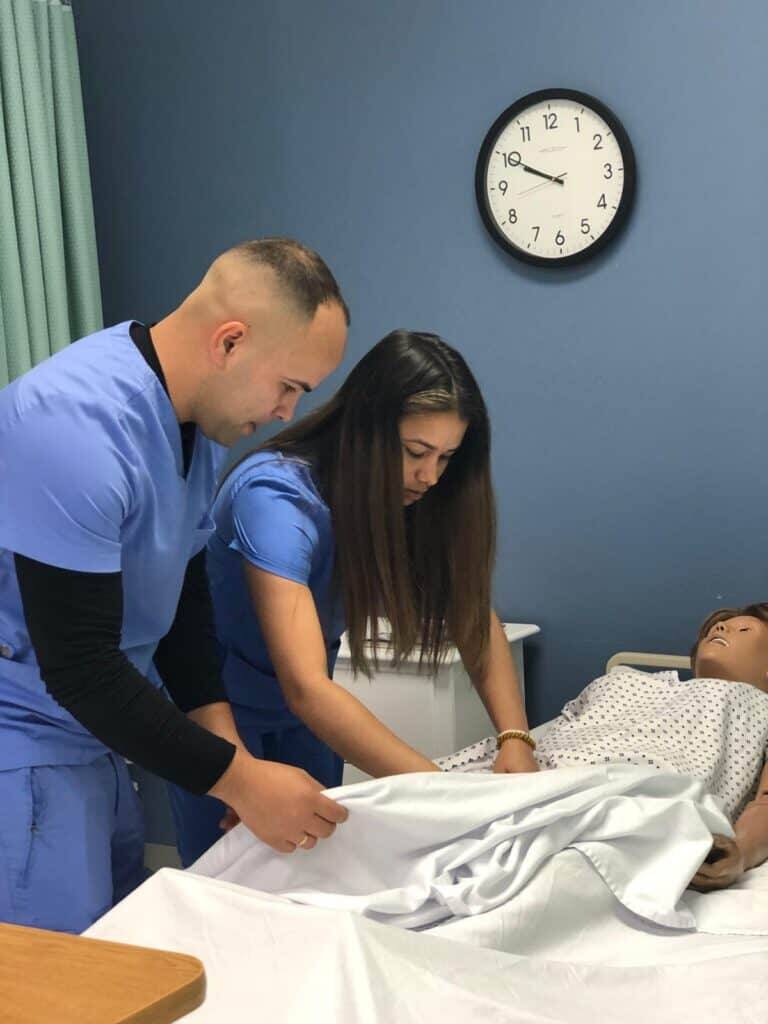
Severe Nursing Assistant Shortage Expected to Grow in Florida
Florida’s healthcare system is facing a critical challenge that will shape the future of patient care for years to come: a severe and growing shortage of nursing assistants. According to the Florida Center for Nursing’s (FCN)2022–2037 Workforce Projections Report, the state began 2022 with a small surplus of nursing assistants, but that balance is expected to shift dramatically within the next decade.
By 2037, Florida could face a shortfall of more than 44,000 full-time nursing assistants, making it one of the most significant workforce gaps in the state’s healthcare sector. This projected shortage not only highlights the urgent need for new healthcare professionals but also presents an incredible opportunity for those considering entering the field.
Florida Center for Nursing Report: Key Findings
The FCN’s data paints a clear picture of a workforce in transition. In 2022, Florida’s supply of nurse assistants exceeded demand by about 17,000 full-time equivalents (FTEs). An FTE is a standard way of measuring employment levels based on full-time work hours rather than the total number of individuals employed.
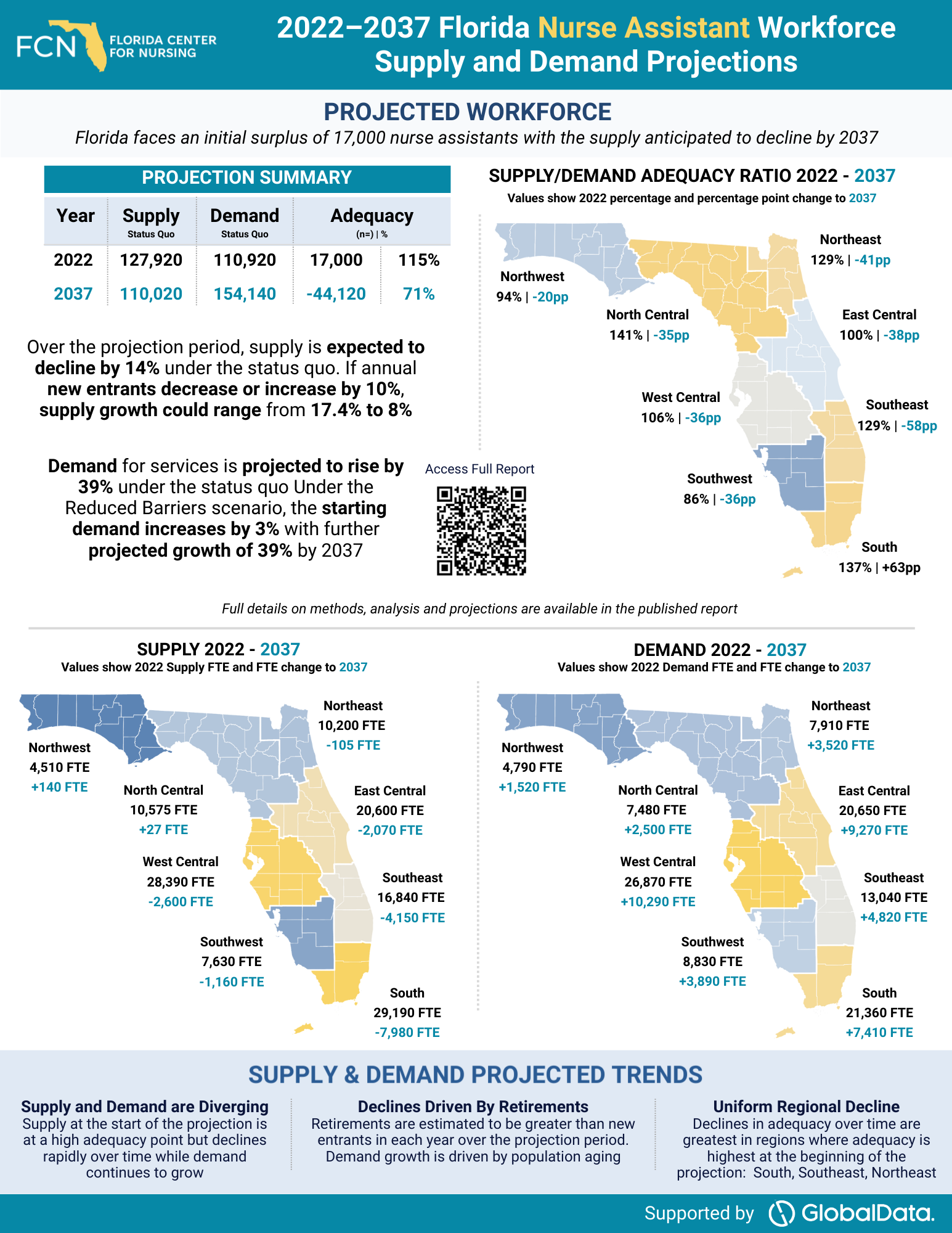
However, that surplus is expected to vanish – and then reverse – as the state’s population ages and more healthcare professionals retire.
By 2037, in Florida:
- Demand for nurse assistants is projected to increase by 39%.
- Supply is expected to decline by 14%.
- Overall adequacy of the nursing assistant workforce will drop from 115% in 2022 to just 71% in 2037.
The South and Southeast regions of the state are projected to experience the most significant shortages.
- In Southeast Florida, adequacy is expected to decline by 58 percentage points, falling from 129% in 2022 to 71% in 2037.
- In South Florida, supply is projected to decline by nearly 8,000 FTEs, while demand grows by more than 7,400 FTEs.
These trends underscore a growing imbalance between the need for patient care and the available workforce, especially in the areas surrounding Miami, Miramar, and Fort Lauderdale.
What’s Driving the Nursing Assistant Shortage in Florida
Several factors are fueling this widening gap between workforce supply and demand:
- An Aging Workforce: Many current nursing assistants are nearing retirement age, and new entrants are not keeping pace with the rate of exits.
- Population Growth and Aging: Florida continues to attract retirees and older adults, particularly in South Florida, which increases the demand for long-term and home-based care.
- Limited New Entrants: Fewer individuals are entering Certified Nursing Assistant (CNA) training programs, often due to lack of awareness about how quickly one can begin a healthcare career.
These combined trends are creating an urgent need for well-trained nursing assistants to support hospitals, nursing homes, and home health agencies across the state.
The Impact on Patients and Florida’s Healthcare System
If left unaddressed, the nursing assistant shortage could have far-reaching effects on patient care and the overall healthcare system. Nursing assistants play an essential role in day-to-day patient support, helping with bathing, feeding, mobility, and vital sign monitoring.
A shrinking workforce means that:
- Patients could experience longer wait times for essential care in hospitals and long-term care facilities.
- Healthcare teams may face increased workloads, potentially affecting the quality and timeliness of care.
- Elderly and chronically ill patients in home health settings may struggle to access consistent support.
The shortage emphasizes just how critical nursing assistants are to maintaining compassionate, safe, and effective healthcare delivery across Florida.
Why This Is the Right Time to Become a Nursing Assistant in South Florida
While this workforce gap presents a major challenge, it also creates a powerful opportunity for people seeking meaningful, stable, and in-demand careers.
According to the Bureau of Labor Statistics (BLS), national employment for nursing assistants and orderlies is projected to grow by 2% from 2024 to 2034, which is a modest rate. However, replacement needs are high, meaning many job openings will arise as current workers retire or leave the field, ensuring steady hiring nationwide.
In Florida, the picture is even more promising: regional demand will far outpace national averages, particularly in South and Southeast Florida.
For anyone looking to start a healthcare career, becoming a Certified Nursing Assistant (CNA)is one of the fastest and most accessible entry points. The role provides immediate experience in patient care and serves as a valuable stepping stone toward more advanced nursing positions, such as Licensed Practical Nurse (LPN) or Registered Nurse (RN).
Key advantages of pursuing a nursing assistant career include:
- Rapid entry into the workforce: FVI’s Nursing Assistant / Home Health Aide program can be completed in just 9 weeks, including classroom instruction and hands-on externship experience.
- Strong job stability: Consistent hiring across hospitals, assisted living facilities, and home healthcare organizations.
- Pathways for career growth: CNAs can advance their education and move into higher-level nursing programs.
- Meaningful work: The chance to make a difference in patients’ lives every single day.
With the growing demand across South Florida, now is the perfect time to start your journey with a trusted nursing assistant school in South Florida.

DDRU of America: Tackling Florida’s Home-Care Crisis by Investing in the Workers Who Care for Our Seniors
Orlando fl — sept 9, 2026
Florida has the seniors. Now Florida needs the caregivers.
Florida is facing a direct-care workforce problem that can no longer be ignored.
The latest America’s Health Rankings Senior Report ranks Florida 50th in the nation—last among all states—for the availability of personal care and home health aides, with only about 17 workers per 1,000 Floridians age 65 and older, compared with a national average of 65.
The situation is especially troubling because Florida has one of the nation's largest populations of older adults. Current Census data show that 22.8% of Florida's population is age 65 or older, representing millions of residents who may need assistance as they age.
The question is simple: Who is going to take care of Florida's seniors?
DDRU of America believes the answer must include building, supporting and fairly compensating a strong workforce of CNAs, HHAs, Nursing Assistants and other direct-care professionals.
DDRU: Addressing the Problem at the Workforce Level
DDRU of America is taking a different approach to Florida's healthcare workforce crisis.
Rather than simply talking about the shortage, DDRU is working to recruit healthcare workers, connect qualified workers with employment opportunities, promote education and career advancement, and advocate for better wages and benefits.
The organization believes that Florida cannot solve a caregiver shortage while treating direct-care careers as low-wage jobs.
If Florida needs more caregivers, Florida must make caregiving a career people can afford to pursue.
That means better wages.
Better benefits.
More educational opportunities.
Greater respect.
And stronger career pathways.
Low Pay Is Part of the Problem
Home health aides and other direct-care workers perform physically and emotionally demanding work.
They may help seniors get out of bed, bathe, dress, eat, move safely, maintain personal hygiene and remain independent in their homes.
For some patients, a caregiver may be the person who makes it possible for them to remain at home rather than entering a nursing facility.
Yet low compensation can make recruitment and retention extremely difficult.
Florida's own Agency for Health Care Administration has identified the shortage of non-licensed direct-care workers—including home health and personal care aides—and notes that low pay undermines workforce stability and creates a barrier to recruiting and retaining direct-care workers.
DDRU believes that has to change.
DDRU's Answer: Recruit. Train. Employ. Advocate.
DDRU's workforce strategy is built around creating a pipeline of people who want to enter healthcare—and giving them a reason to stay.
1. Recruit the next generation
DDRU wants young people to see CNA and HHA careers as legitimate professional opportunities—not dead-end jobs.
The organization supports programs that introduce young adults to healthcare careers and encourage them to pursue CNA and HHA education.
2. Help people get trained
Education is one of the keys to solving the shortage.
DDRU supports scholarships, training opportunities and career-development initiatives designed to help qualified individuals enter the direct-care workforce.
3. Connect workers with employment
DDRU also promotes employment opportunities for qualified healthcare workers.
The goal is to help CNAs, HHAs, NAs and MAs find opportunities that match their skills, experience and career goals.
4. Give workers a stronger voice
DDRU believes workers should not have to face employers alone when negotiating wages, benefits and workplace conditions.
Through collective action and advocacy, workers can have a stronger voice in discussions about compensation, staffing, benefits and career advancement.
DDRU Is Also Fighting for Higher Wages
DDRU's answer to Florida's workforce crisis goes beyond recruitment.
The organization is advocating for policies that would make direct-care employment more financially sustainable.
DDRU has proposed the Florida Direct Care Healthcare Workforce Wage Act, which calls for a $35-per-hour starting wage for qualifying CNAs, Nursing Assistants and Home Health Aides, together with a reimbursement framework designed to help qualifying healthcare providers address increased labor costs.
The proposal reflects DDRU's position that Florida cannot simultaneously demand more caregivers while allowing compensation to remain too low to attract and retain them.
A stronger workforce requires a stronger investment in the workforce.
Why Union Representation Matters
DDRU believes that a healthcare worker should have options.
A worker should not feel trapped in one facility because leaving means losing access to good wages, benefits or career opportunities.
Union representation can provide workers with a collective voice concerning wages, benefits and working conditions, while collective bargaining can establish negotiated standards between workers and employers.
For DDRU, the goal is not simply to get someone hired.
The goal is to help healthcare workers build sustainable careers.
That includes advocating for:
• Competitive wages
• Better benefits
• Safer working conditions
• Educational advancement
• Career development
• Fair treatment
• Stronger staffing standards
• Professional recognition
• Opportunities to advance
Florida's Caregiving Crisis Requires Action Now
Florida's ranking should be a wake-up call.
The state ranks 50th in home health and personal-care aide availability, while its older population continues to create enormous demand for caregivers.
This isn't just a workforce issue.
It is a family issue.
It is a senior-care issue.
It is a patient-safety issue.
And it is an issue that affects the future of Florida's entire healthcare system.
When there aren't enough caregivers, families can struggle to find help. Existing workers can face heavier workloads. Providers can struggle to recruit and retain staff. And vulnerable Floridians can face difficulty obtaining the care they need.
Florida cannot afford to wait until the shortage becomes even worse.
DDRU's Message to Florida
DDRU of America believes Florida has an opportunity to turn this crisis into a workforce transformation.
Recruit more people.
Train more people.
Pay people better.
Protect their careers.
Give them benefits.
Create advancement opportunities.
And make direct-care healthcare work a career people can build a life around.
DDRU is calling on healthcare employers, educators, community leaders, legislators and healthcare professionals to work together on solutions.
Because the people who care for Florida's seniors deserve to be cared for, too.
DDRU OF AMERICA
Standing for CNAs • HHAs • Nursing Assistants • Medical Assistants
Higher Wages. Better Benefits. Stronger Healthcare Workers.
DDRU's message is clear: Florida doesn't just need more caregivers. Florida needs to build a workforce that can afford to stay.

US needs 739,000 new home health aides in the next 10 years. Why experts say the pay is barely livable
Florida ranks 50th for availability of home health aides
ORLANDO, Fla. – With America’s population aging, it makes sense that the industry expected to see the most growth in the next decade is the home health care industry.
The U.S. Census predicts that by 2034, older adults will outnumber people under the age of 18 for the first time in the country’s history.
The U.S. Bureau of Labor Statistics projects that “home health and personal care aides” will need 739,800 new jobs by 2034, far more than any other occupation.But right now, finding a home health aide, or a personal care aide, is a struggle across the country, and especially in Florida.
“We get these calls every single day from people across the state, calls from people who are approved for these services,” said Caitlyn Clibbon, an attorney with Disability Rights Florida. “The services have been prescribed and ordered, and they will be paid for by the insurance company. They just can’t get anyone to show up and staff these shifts.”
According to the BLS, the median pay for home health and personal care aides in 2024 was $34,900 a year, or $16.78 an hour.
That’s the second-lowest median salary on the BLS list. Only fast food workers make less.
What it takes to be a home health or personal care aide
Not much formal education is required to be a home health or personal care aide – typically just a high school diploma is needed.
Aides for home health agencies can follow training guidelines or pass competency tests or evaluations, depending on the industry, according to the Florida Agency for Health Care Administration. There’s no state license or certification for home health aides though.
Aides help people with chronic illnesses, disabilities, or older people with daily tasks like housekeeping, organizing, and helping with appointments, bathing or dressing, shopping for groceries, cooking, and more.
“They could be things like helping someone who physically needs to transition from, you know, a chair into a bed or to use the restroom. So they could be physically demanding, having to lift an entire human being and get them repositioned or into a new setting,” Clibbon said.
“There are people who are receiving in-home health services that if they did not receive them, they would die within a day or two. There are people who need to be suctioned and tube-fed, and those sorts of things, hourly or every other hour. So it’s a detail-oriented, high-intensity, you have to be paying attention 100% of the time kind of job,” Clibbon added.
As older people try hard to stay in their homes and not go to assisted living facilities, home health aides have become more important. According to an AARP report last year, 24 million U.S. adults age 50 and older live alone. That includes 1 in 3 people age 55 to 74, and half of people age 75 and older.
Florida last for home health aide availability
Florida has the second-largest population of people over the age of 65, but ranks 50th in the availability of home health and personal care aides, with roughly 16 aides per 1,000 seniors in the state, according to the 2025 America’s Health Rankings Senior Report by the United Health Foundation.
Florida also has nearly 3.2 million people with a disability, according to the 2024 American Community Survey by the U.S. Census Bureau, with 1.6 million under the age of 65.
“So most of these folks are going to be on Medicaid and Medicare. Often, private insurance does not cover these kinds of services anyway,” Clibbon said.
“Some of these folks are literally making minimum wage to do a very important job,” Clibbon said. “I mean, imagine if this was your loved one that you were looking for a caregiver for. Like, you’re not just looking for the cheapest whatever you can find.”
Licensed practical nurses working as home health aides receive a maximum fee of $27.06 per visit, and registered nurses receive $32.07 per visit.
Recent efforts to increase training programs for nurses are one way the state is trying to get more people into the profession, but the Home Care Association of Florida also says the state has to do something about pay.
“Close the workforce gap by raising Medicaid reimbursement rates and increasing compensation for home care workers,” the agency said last year.
The Home Care Association of Florida is hosting a daylong event in Tallahassee next month to press state lawmakers on the issue during the annual legislative session.

Florida is implementing significant changes for Certified Nursing Assistants (CNAs) through 2026 and 2027, pushing for higher wages starting at $35 an hour, and expanding career paths Lead by DDRU nursing union.
Orlando Times:
Staff report Sept. 8, 2026
DDRU 'S push for higher wages is coming closer:
The proposed $35 wage is becoming part of a broader conversation about how Florida pays and retains the workers responsible for much of its hands-on healthcare.
For workers, the issue is straightforward: they say they need wages that allow them to support themselves and their families.
For employers and policymakers, the challenge is determining how higher compensation can be financed while maintaining access to affordable healthcare and long-term care.
And for patients and families, the question is whether Florida can build a workforce stable enough to provide consistent care as demand continues to grow.
DDRU President Bass says his organization intends to remain involved in that debate.
“These workers take care of somebody else’s mother, father, grandmother, grandfather, brother, sister or loved one,” Bass said. “They deserve to be respected, protected and compensated accordingly.”
DDRU says it currently has nearly 6,000 CNAs, HHAs, Nursing Assistants and affiliates in Florida and plans to expand its organizing, education and legislative efforts.
The organization says its next major objective will be bringing its proposed Direct Care Healthcare Workforce Act before Florida policymakers as the 2027 legislative session approaches.
The Role of the CNA in Specialized Care Units
Florida's aging population has led to a surge in specialized Memory Care and Ventilator-Dependent units. The Board of Nursing’s 2026 guidance suggests that CNA students receive more targeted education on dementia and Alzheimer’s care as part of their initial certification preparation.
This isn't just about safety; it’s about the quality of life. The 2026 standards challenge CNAs to use de-escalation techniques and therapeutic communication when working with residents experiencing cognitive decline. This shift recognizes the CNA as the primary emotional support for many residents, elevating the profession's status and requiring a more sophisticated educational foundation.
Updated Staffing Ratios and the Demand for CNAs
Florida Senate Bill (SB) 630 and subsequent Board of Nursing reviews have continued to refine the minimum staffing requirements for nursing homes across the state. In 2026, the focus remains on ensuring that residents receive a minimum of 3.6 to 4.1 hours of direct care per day. Because CNAs provide the vast majority of this hands-on care, the demand for certified professionals in Orlando and the surrounding Central Florida region is projected to grow by 8-12% over the next three years.
For students, this means that while the certification process is becoming more rigorous, the return on investment is higher than ever. Starting salaries for CNAs in Florida are seeing an upward trend. Furthermore, the 2026 updates include provisions for 'Career Ladder' incentives, where the Board of Nursing encourages facilities to provide tuition reimbursement for CNAs moving toward their LPN (Licensed Practical Nurse) or RN (Registered Nurse) credentials.

FL. Nursing union announces new contract negotiations and backs proposed $35-an-hour starting wage for CNAs, HHAs and nursing assistants
Miami Herald PT
By Staff Reporter
Florida — September 2026
Florida’s debate over healthcare workforce shortages is increasingly turning toward the workers who provide hands-on care every day.
DDRU of America Nursing Union, an organization representing and organizing Certified Nursing Assistants, Home Health Aides and Nursing Assistants, is stepping up its campaign for higher wages and improved working conditions as it moves into a new round of contract negotiations at seven state-owned nursing facilities.
The union says the negotiations are part of a broader strategy to make direct-care healthcare careers more financially sustainable while addressing the recruitment and retention problems facing nursing facilities, hospitals, home-health agencies and other healthcare providers.
At the center of DDRU’s campaign is a proposed $35-per-hour starting wage for qualifying direct-care workers.
Union officials say the proposal could become part of a broader legislative package they hope Florida lawmakers will consider during the 2027 legislative session.
‘It’s time to show appreciation’, DDRU President Mr Bass says the push is about more than increasing hourly pay.
Bass argues that the rising cost of housing, food, transportation and other necessities has made it increasingly difficult for many healthcare workers to remain in lower-paying positions.
“Now that the playing field is leveled, it’s time to show appreciation to American healthcare workers,” Bass said.
He also pointed to the sacrifices made by healthcare workers during the COVID-19 pandemic.
“Our healthcare workers stood on the front lines during COVID and many lost their lives taking care of other people’s loved ones,” Bass said. “Now it is time for them to be paid fairly and receive the benefits they have earned.”
Bass said DDRU intends to continue pressing the issue through collective bargaining as well as legislative advocacy.
From contract negotiations to the State Capitol, The union’s latest organizing effort comes as Florida healthcare providers continue confronting the challenge of maintaining an adequate direct-care workforce.
CNAs, HHAs and nursing assistants perform many of the daily tasks that allow nursing facilities and other healthcare settings to operate. Their responsibilities can include assisting patients with mobility, personal care, daily activities and other essential needs.
DDRU contends that when wages are not competitive, experienced caregivers may leave the profession or move to other employers offering better compensation.
The union believes higher wages could help employers recruit new workers while giving experienced caregivers greater incentive to remain in the field.
Its proposed Florida Direct Care Healthcare Workforce Act would seek to address those concerns through a combination of wage, workforce and policy initiatives.
According to DDRU, the proposed legislation would focus primarily on CNAs, HHAs and Nursing Assistants and establish a $35-an-hour starting wage for qualifying workers.
The proposal is expected to generate discussions involving lawmakers, healthcare employers, state agencies and representatives of the direct-care workforce. A $35 hourly starting wage would represent a significant increase over what many direct-care workers currently earn.
At 40 hours per week, a $35 hourly wage would equal approximately $72,800 in annual gross wages before taxes, although actual earnings would vary based on hours worked, overtime, benefits and individual employment arrangements.
DDRU argues that the cost of maintaining an understaffed workforce—including employee turnover, recruitment and training—must also be considered. A workforce issue with statewide implications
The debate comes at a time when Florida’s healthcare system is facing growing demand for workers capable of providing direct patient care.
Florida has one of the nation’s largest populations of older adults, increasing the demand for long-term care, home-health services and other forms of assistance.
For nursing facilities, keeping experienced employees can be particularly important because direct-care workers often develop familiarity with residents and their individual needs.
DDRU says improving wages and benefits could help create a more stable workforce.
The organization is also advocating for improved staffing standards and stronger workplace protections as part of its broader organizing campaign.
Collective bargaining remains a key strategy
While legislative advocacy is becoming an increasingly visible part of DDRU’s campaign, union officials say collective bargaining remains central to their approach.
The organization says CNAs represented by DDRU at seven state-owned nursing facilities are entering new contract negotiations focused on wages, benefits and working conditions.
The union maintains that employees should have a meaningful voice in determining the conditions under which they work.
DDRU also says it will continue using lawful labor strategies when negotiations fail to produce what members consider acceptable
“These workers take care of somebody else’s mother, father, grandmother, grandfather, brother, sister or loved one,” Bass said. “They deserve to be respected, protected and compensated accordingly.”
DDRU says it currently has nearly 6,000 CNAs, HHAs, Nursing Assistants and affiliates in Florida and plans to expand its organizing, education and legislative efforts through a strong social media presence now involving younger, CNA‘s
and HHA’s to push their social movement.
“ Many of our members are older, not Tech savvy and can care less about social media. However, this new generation is all about social media, tech and they definitely need higher wages. Thus, The young DDRU members will push healthcare wages to where they need to be. You have to pay these young people. “ Bass concluded
The DDRU organization says Has proposed Direct Care Healthcare Workforce Act before Florida policymakers as the 2027 legislative session approaches.
For more information about DDRU of America and its healthcare workforce initiatives, visit DDRU.org or contact admin@ddru.org.

DDRU union Addresses complaints that Haitian and Venezuela immigrant detainees do not hold the same medical rights as other humans in Florida…
Miramar Fl. -
The DDRU union, representing more than 5,600 healthcare workers in Florida, has called out South Florida’s ICE detention centers for jeopardizing the rights, health, and safety of patients in custody of immigration enforcement agencies.
DDRU’s president, Mr. Bass, sent a letter Thursday to Governor Ron DeSantis’s office in Tallahassee, demanding that Florida’s ICE detention centers comply with state policies and statutory obligations regarding immigrants in custody.
Since the ending of TPS, U.S. Immigration and Customs Enforcement has recently been bringing detainees to Alligator Alcatraz, ERP Center Miramar, and Glades County for Detainment.
DDRU is monitoring the aggressive treatment towards Haitians and Venezuelans by officers. These immigration officers are freezing Haitians' vital medical treatment that they are supposed to receive. Some are not receiving their diabetes, asthma, cholesterol, high blood pressure, and antidepressant medications.
DDRU president Mr. Bass stated that "many of these people are healthcare workers. They worked at hospitals, nursing homes, assistant living facilities, and in private duty care. They did a lot of jobs that served the community. These are the same people that risked their lives during Covid and took care of our loved ones and the elderly people of Florida. Thus, how can we turn our backs on them and let these detention center officers mistreat them? - Not on my watch! Mr. Bass stated
"The state of Florida must be committed to providing proper medical care to everyone who needs it, including individuals who are in custody and regardless of immigration or citizenship status. We all have to follow rules, and even ICE have to be compliant with its own policies, adhere to state and federal laws, and try better to protect the rights and health of immigrants, whom 80% were hard-working, law-abiding, and tax-paying individuals.” He stated
The DDRU president also stated, "That regardless of immigrants' status, they deserve the same HIPAA rights as others in need of healthcare in Florida." We need all of our nurses and healthcare workers to stand in solidarity with the 15,000 healthcare workers that we lost due to TPS; they still need our support and donations as they’re going through this hardship period of time. They need our voices, and us marching. They need to know that they matter and they need to know that we thank them for their service in our state of Florida. We need to thank them for taking care of our elderly people and our loved ones. Mr. Bass concluded. To learn more about the DDRU union and movement, go to www.ddru.org.

DDRU PRESIDENT MR. BASS SPONSORS THREE YOUNG ADULTS TO BEGIN CNA & HHA CAREERS IN ORLANDO
“Each One Teach One” — DDRU Turns Mentorship Into Opportunity for the Next Generation of Healthcare Workers
ORLANDO, FL — August 31, 2026 — The President of DDRU of America, Mr. Bass, is putting the union’s commitment to young people into action by sponsoring three young adults to attend Southern Technical Institute in Orlando, Florida, where they will pursue education and training to become Certified Nursing Assistants (CNAs) and Home Health Aides (HHAs).
For Mr. Bass, the initiative is about more than helping three students enter healthcare. It is about creating a cycle of opportunity in which one person’s success becomes another person’s opportunity.
His motto is simple:
“Each One Teach One.”
Mr. Bass explained that he is not asking the young people to simply receive assistance and walk away. Instead, he hopes that once they establish themselves in their careers, they will help another young person get the same opportunity.
“All I ask in return is once they're secure in their career, is to help DDRU send another kid to school,” Bass said.
From the Classroom to the Workforce
DDRU says its goal is to help young adults see healthcare as a legitimate pathway toward a stable career, financial independence and the opportunity to serve their own communities.
For many young people, getting into a healthcare career can be difficult because of the cost of education, transportation, training and other barriers that stand between them and employment.
The DDRU scholarship initiative is designed to help remove some of those barriers while connecting aspiring healthcare workers with mentorship and union advocacy.
Mr. Bass says the ultimate objective is not simply to get young people into school—it is to help them stay in the healthcare workforce and build long-term careers.
“Sisters and Brothers, Love Overrides Oppression and Discrimination”
When asked why he personally believes in investing in young people, Mr. Bass offered a message that he says represents the philosophy behind DDRU.
“Sister's and brother's love override oppression and discrimination. We can't talk about it. We have to be about it.”
He continued:
“We have to fight to get these kids in school and get them inside of a workforce. Then we have to make sure that employers pay them right and give them the right wages and benefits, so they can afford a long career of working to take care of themselves and family.”
According to Bass, education is only the beginning. Once these new healthcare professionals enter the workforce, DDRU intends to advocate for fair compensation, benefits, educational advancement and better working conditions.
A Different Kind of Union
Bass says DDRU wants to build a union model that connects education, mentorship, employment and collective bargaining.
“Thus, once these young people are working, we have to hold hospitals and health agencies accountable through collective bargaining for the best benefits, wages, and educational advancement possible for our members.”
He added:
“This is a new day and time and this is a different type of union.... We love our people!”
The three sponsored students represent the first step in what DDRU hopes will become a larger pipeline of young adults entering the direct-care healthcare workforce.
DDRU Advocates for Higher Direct-Care Wages
The scholarship initiative comes as DDRU continues its stated effort to increase compensation for frontline healthcare workers throughout Florida.
Mr. Bass is currently proposing to
Senator Rick Scott and Representative Sam Greco of Florida House of Representatives — District 19, the
“FLORIDA DIRECT CARE HEALTHCARE WORKFORCE WAGE ACT”
As described by DDRU, the proposed legislation would establish a $35-per-hour minimum base wage for qualifying Certified Nursing Assistants, Home Health Aides and Nursing Assistants, while creating a Medicaid/AHCA reimbursement framework intended to help qualifying healthcare providers meet increased labor costs.
The proposal is part of DDRU's broader argument that Florida cannot build a strong healthcare workforce without investing in the workers who provide hands-on care every day.
Education + Good Jobs + Fair Wages
DDRU's position is that getting young people into healthcare training is only one part of solving the workforce challenge.
The organization says young workers also need:
- Access to CNA and HHA education
- Scholarship opportunities
- Mentorship and career guidance
- Good-paying jobs
- Benefits and retirement opportunities
- Opportunities for educational advancement
- A voice in their workplace
- Collective bargaining protections
- Opportunities to build long-term careers
The organization says its vision is to help create a cycle where today's scholarship recipient can eventually become tomorrow's mentor, union member and community leader.
“Each One Teach One”
For DDRU, the three students sponsored by Mr. Bass are more than scholarship recipients. They are intended to become part of a continuing chain of opportunity.
One student gets an opportunity.
That student builds a career.
That career creates stability.
And that successful worker helps another young person get started.
That is the meaning behind “Each One Teach One.”
HELP DDRU SEND THE NEXT STUDENT TO SCHOOL
DDRU is also inviting community members, businesses, healthcare supporters and others who believe in creating opportunities for young people to support its scholarship and mentorship efforts.
DDRU invites you to support our members and affiliates. Your generous donations help fund HHA and CNA scholarships for young adults. Help DDRU educate and mentor these aspiring healthcare professionals who are dedicated to serving their communities. All donations are vital in making DDRU programs possible.
For more information about DDRU of America, its workforce initiatives, membership, scholarships and opportunities, visit:
DDRU of America
Educate. Mentor. Organize. Empower.

DDRU Union Nurses Are earning $8,000–$10,000 a month.
Florida -
DDRU’s president says “ yes some of our nurses are making $8000-$10,000 a month at this time, with the end of TPS however, the bigger goal is helping our CNA and HHA nurses earn more without sacrificing their lives to overtime. DDRU healthcare workers are making serious money, but they have to work Alot of extra hours. “ he stated
Of course Double shifts, Weekends and Overnight assignments for some CNA nurses can produce impressive paychecks - but it can also come with a serious price: - Burnout.
DDRU of America Nursing Union says it wants to change the conversation.
The organization is working to help healthcare professionals pursue better-paying opportunities while advocating for improved wages, benefits, staffing standards and career advancement.
Since TPS have ended , some of DDRU members, monthly earnings are in the $8,000–$10,000 range and can become possibly higher with travel opportunities or additional responsibilities.
DDRU says workers should understand an important distinction: “ Making more money is not the same thing as having a better quality of life.”
DDRU member Nicole Allen knows that lesson firsthand. Allen says “ that as a single mother, she consistently worked approximately 70 hours a week because she needed the income to support her family. “ At one point, she says she was bringing home approximately $9,000 a month working as an union CNA.
“Yes the money is Good, But the schedule eventually caught up with me and The burnout is real.” She concluded
Healthcare workers shouldn’t have to destroy their health just to earn a decent living. Reaching $8,000–$10,000 in a particular month can therefore require circumstances beyond a standard 40-hour schedule.
Those circumstances include:
- Higher-paying union or specialty assignments
- Overtime
- Night, weekend or holiday differentials
- Travel assignments
- Higher-level credentials
- Additional shifts
- Specialized patient-care experience
- Multiple income opportunities within the healthcare field
For example, $9,000 per month represents approximately $108,000 annually if maintained for an entire year and DDRU is currently helping their union members make these wages with all the extra work available.
DDRU believes the future of healthcare employment wages should start at $35 an hour, so CNA‘s do not have to work another 12-hour shift to bring home good money.
DDRU’s broader message is that healthcare professionals deserve opportunities for:
Better wages.Better benefits.Better working conditions.Career advancement.Stronger staffing standards. And a voice in the workplace.
The organization advocates specifically for CNAs, HHAs, and NAs while also promoting career advancement throughout the healthcare workforce.
The Real Question Isn’t “How a $9,000 monthly income can sound incredible on paper—but if achieving it requires working 70 hours every week, raising children, attending school and constantly picking up additional shifts, the financial reward can eventually become difficult to sustain.
DDRU says its vision is not simply to create workers who can earn $8,000, $9,000 or $10,000 a month.
Its vision is to help build a healthcare workforce where professionals can pursue higher income without believing that exhaustion is the price of success.
DDRU of America’s union president, Mr. Bass is proposing To Senator Jennifer Bradley and Representative Chase Tramont; The “ FLORIDA DIRECT CARE HEALTHCARE WORKFORCE WAGE ACT: “
The proposed legislation would establish a $35-per-hour minimum base wage for qualifying Certified Nursing Assistants, Home Health Aides, and Nursing Assistants while creating a Medicaid/AHCA reimbursement framework designed to help qualifying healthcare providers meet the increased labor costs……..
Therefore, CNA‘s and HHA’s if you are really chasing that $9000 a month income, you should join DDRU of America’s movement at www.DDRU.Org

DDRU of America Announces New Opportunities for Top-Paying CNA, HHA, NA & MA Jobs Across Florida
FOR IMMEDIATE RELEASE
Miami Herald,El Nuevo Herald,Miami New Time,Orlando Sentinel
Florida — August 27, 2026 — DDRU of America is expanding its employment and advocacy efforts for Certified Nursing Assistants (CNAs), Home Health Aides (HHAs), Nursing Assistants (NAs), and Medical Assistants (MAs) throughout Florida. Through its workforce network, DDRU connects qualified healthcare workers with flexible employment opportunities and advocates for stronger wages, benefits, workplace protections, and career advancement.
Florida continues to face significant healthcare workforce challenges. The Florida Hospital Association has projected a substantial nursing workforce shortage in the coming years, while CNA demand remains strong across hospitals, long-term-care facilities, home health, rehabilitation, and other care settings.
Why Consider a Union Healthcare Job?
A union job can give healthcare workers a stronger collective voice in discussions about wages, benefits, staffing, workplace conditions, and other employment issues. Through collective bargaining and worker advocacy, unions can help employees organize around common workplace priorities rather than having to face those issues alone. Florida healthcare workers have previously used collective bargaining to secure wage increases and stronger workplace protections.
DDRU believes healthcare professionals should not feel trapped in one facility or one assignment. Depending on the position and employer, workers may have opportunities to pursue different assignments, facilities, shifts, and care environments. If a worker is unhappy with a particular workplace, DDRU's workforce network is designed to help connect qualified caregivers with other opportunities rather than leaving them without options. DDRU states that it supports temporary, permanent, and on-demand assignments and works to connect caregivers with opportunities that fit their preferences.
DDRU Advocates for Better Pay and Benefits
DDRU's mission goes beyond helping healthcare workers find jobs. The organization says it advocates for fair compensation, due process, workplace rights, and higher wages for caregivers and healthcare workers. DDRU also supports legislative efforts aimed at improving compensation for frontline healthcare professionals, including its campaign advocating for higher starting wages for CNAs and HHAs in Florida.
DDRU's message to Florida's healthcare workforce is simple: your work matters, your voice matters, and you deserve an organization willing to stand beside you.
Find Your Next Healthcare Opportunity
Healthcare workers looking for CNA, HHA, NA, MA, caregiver, independent-care, and other available opportunities can visit DDRU.org to explore current opportunities and learn more about DDRU membership and workforce services.
DDRU also provides a platform for independent caregivers and independent CNAs who work for themselves. Qualified independent care providers can use DDRU's network to promote their services and seek higher-paying private-care opportunities directly from potential clients.
For healthcare professionals ready to take the next step in their careers, DDRU encourages workers to explore available opportunities, learn about union advocacy, and consider the advantages of having an organization working alongside them for better wages, benefits, and workplace protections.
DDRU OF AMERICA
Protecting. Educating. Advocating.
CNA • HHA • NA • MA • Caregivers

Florida Remains Last in Nation for Home Health Worker Availability as Senior Population Grows.
DDRU reports, A newly released national report once again highlights Florida’s growing home care workforce crisis, despite increasing demand for services from the state’s rapidly expanding older adult population.
Florida ranks 50th — last in the nation — in the availability of home health care workers, with just 17 workers per 1,000 adults age 65 and older, compared to the national average of 65 workers per 1,000 adults age 65 and older.
The report found that while the national home health workforce increased 5% between 2025 and 2026, Florida continues to lag significantly behind every other state in workforce availability. Nationally, the number of home health care workers has increased 38% since 2016, yet substantial geographic disparities persist.
Florida is home to one of the nation’s largest senior populations, with adults age 65 and older representing 21.8% of the state’s total population, well above the national average of 18%. Despite this demographic reality, the state continues to face severe shortages of caregivers and direct care workers needed to support aging in place.
“Florida’s seniors overwhelmingly want to remain safely at home as they age, but that becomes increasingly difficult when there simply are not enough caregivers available to meet the demand,” said Denise Bellville, RN, BS, Executive Director of the Home Care Association of Florida. “Providers across the state continue to face extraordinary workforce shortages driven by inadequate reimbursement, wage competition from other industries, workforce burnout, and the growing complexity of patient needs. Without meaningful investment in home care services and the workforce that delivers them, access challenges will continue to worsen for Florida families.”
The report also noted broader national concerns affecting older adults, including increases in food insecurity, excessive drinking, suicide, and drug deaths among seniors. Adults age 65 and older were the only age group nationally to experience a significant increase in drug-related deaths between 2025 and 2026.
At the same time, the report identified several positive trends nationally, including improvements in physical activity, preventive screenings, reductions in early deaths, and growth in the geriatric clinician workforce.
Florida ranked 30th overall in senior health in the 2026 report. The state performed well in several areas, including hospice care utilization, low obesity prevalence, and nursing home quality measures, but continued to struggle with poverty rates, housing cost burden, mental distress, and workforce-related indicators.
DDRU continues to advocate for policies aimed at strengthening Florida’s home health aides, CNA’s workforce, including increased Medicaid reimbursement rates, workforce development initiatives, regulatory modernization, and strategies to improve recruitment and retention of caregivers and clinicians.

Florida Nursing Home Bill Proposes Expanding CNA Powers to Administer Routine Drugs
DDRU report, that they are trying to bring back a senate bill that would free up time for RN nurses for more advanced patient care by permitting CNAs to become trained as “qualified medication aides,” allowing them to administer routine medications and perform tasks such as checking residents’ blood glucose levels.
Florida Health Care Association (FHCA) chief executive officer Emmett Reed told (https://thecapitolist.com/florida-moves-to-address-nursing-shortage-with-new-medication-aide-training-bill/) The Capitolist that the legislation would help address the historic nursing workforce shortage by enhancing job satisfaction for nurses and offering CNAs opportunities to earn higher wages and broaden their career paths in nursing.
“ When RN nurses can concentrate on higher-level care, they can better detect medical conditions early, leading to more successful treatment outcomes and fewer costly trips to the hospital for residents,” Reed said.
Mr. Bass The President, DDRU of America Nursing Union, entered the conversation swiftly.
“ There is something fundamentally wrong with the way America continues to treat Certified Nursing Assistants and Home Health Aides, If You Want CNAs to Do More, Then Pay Them More.”
Mr Bass continued , “ When healthcare facilities need more work done, they look to the CNA. When nurses are overwhelmed, they look to the CNA. When facilities are short-staffed, they ask the CNA to take on additional responsibilities. And now we are seeing proposals and laws that expand the responsibilities that CNAs can perform, including medication-related duties and other patient-care tasks.” He continued
“ But my question as President of DDRU of America Nursing Union is simple:, Where is the additional paycheck for the additional responsibility? “ He asked
Florida’s current law already provides a pathway for certain CNAs to become qualified medication aides. Under the law, eligible CNAs can receive additional training in medication administration and associated tasks, including blood-glucose checks, and can perform delegated medication duties under the required nursing supervision.
“ DDRU does not believe that CNAs should be denied opportunities to advance, We believe they should be paid for advancing. A CNA who spends additional hours in training, passes competency requirements, accepts additional responsibility for medication-related duties and assumes greater accountability for patient safety should not simply receive a pat on the back and the same hourly wage. That is not career advancement!” Mr Bass Concluded

DDRU Fact Sheet: Nursing Shortage
The U.S. is experiencing a shortage of Registered Nurses (RNs) that is expected to intensify as
Baby Boomers age and the need for healthcare grows. Compounding the problem is the fact
that nursing schools across the country are struggling to expand capacity to meet the rising
demand for care. The American Association of Colleges of Nursing (AACN) is working with
schools, policymakers, nursing organizations, and the media to bring attention to this
healthcare concern. AACN is leveraging its resources to shape legislation, identify strategies,
and form collaborations to address the shortage.
Current and Projected Shortage Indicators
• According to the Bureau of Labor Statistics’ Occupational Outlook Handbook, the
Registered Nursing (RN) workforce is expected to expand by 5% over the next
decade. The RN workforce is anticipated to grow from 3.39 million in 2024 to 3.56
million in 2034, an increase of 166,100 nurses. The Bureau also projects 189,100
openings for RNs each year through 2034 when nurse retirements and workforce
exits are factored into the number of nurses needed in the U.S.
• The Advanced Practice Registered Nurse (APRN) workforce, including Nurse
Practitioners, Nurse Anesthetists, and Nurse Midwives, is expected to grow much
faster than average for all occupations, by 35% from 2024 through 2034, according
to the Bureau of Labor Statistics. Approximately 32,700 new APRNs, which are
prepared in master’s and doctoral programs, will be needed each year through 2034 to
meet the rising demand for primary and specialty care.
• According to Nursing Workforce Projections, 2023-2038 published by the Health
Resources and Services Administration (HRSA) in December 2025, federal
authorities project a shortage of 267,330 full-time RNs by 2028. The ten states with
the largest projected nursing shortage in 2038 are
1California (22%), North Carolina (20%), Georgia (20%), Michigan (18%),
Washington (17%), Maryland (16%), Oklahoma (13%), South Carolina (12%),
Louisiana (11%) and Virginia (8%). Data for each state may be accessed through
HRSA’s Workforce Projections Dashboard.
• According to the 2026 NSI National Health Care Retention & RN Staffing Report, the RN
vacancy rate in acute care settings in the U.S. is 8.6%, down from 9.6% in 2024. The
report also found that the RN turnover rate in hospitals is 17.6% with the average time
needed to recruit an experienced RN ranging from 56 to 102 days.
• In May 2026, the International Council of Nurses (ICN) issued a report titled Our Nurses.
Our Future. Empowered Nurses Save Lives, calling for urgent investment in nursing. To
address the shortage of 5.8 million nurses worldwide, ICN called on governments to fund
national workforce plans, improve working conditions, invest in education, expand scope
of practice, and elevate nurse leadership.
• The Institute of Medicine in its landmark report on The Future of Nursing called for
increasing the number of baccalaureate-prepared nurses in the workforce to at least
80% to enhance patient safety. The current nursing workforce falls short of this
recommendation, though more than two-thirds of RNs are educated at the
baccalaureate or graduate level. The exact percentage has been reported as 69% by
HRSA and 72.9% by the National Council of State Boards of Nursing.
Contributing Factors Impacting the Nursing Shortage
Nursing school enrollment is not growing fast enough to meet the projected demand
for RN and APRN services.
Though enrollment in entry-level baccalaureate programs in nursing increased by 7.6% in
2025, AACN reported a drop in PhD programs for the eleventh consecutive year (down 3%).
This trend is raising concerns about the capacity of nursing schools to meet the projected
demand for nurses, including the need for more nurse faculty, researchers, and primary care
providers.
A shortage of nursing school faculty is restricting nursing program enrollments.
• According to AACN’s report on 2025-2026 Enrollment and Graduations in Baccalaureate
and Graduate Programs in Nursing, U.S. nursing schools turned away 92,672 qualified
applications (not applicants) from baccalaureate and graduate nursing programs in 2025
2due to insufficient number of faculty, clinical sites, classroom space, and clinical
preceptors, as well as budget constraints. Within this total, nearly 17,000 applications
were turned away from graduate programs, which limits the pool of potential nurse
educators, given that most full-time teaching roles require a master’s or doctoral
degree.
• According to a Special Survey on Vacant Faculty Positions released by AACN in October 2025,
a total of 1,588 full-time faculty vacancies were identified in a survey of 1,075 nursing
schools with baccalaureate and/or graduate programs across the country (80.3% response
rate). Besides the vacancies, schools cited the need to create an additional 150 faculty
positions to accommodate student demand. The data show a national nurse faculty vacancy
rate of 7.2%. Most of the vacancies (80.8%) were faculty positions requiring or preferring a
doctoral degree.
A significant segment of the nursing workforce is nearing retirement age.
• According to the 2022 National Sample Survey of Registered Nurses, 17% of RNs
working in outpatient, ambulatory, and clinical settings have retired or plan to retire over
the next 5 years.
• Published October 4, 2023, by the Journal of the American Medical Association, Dr.
Melissa Suran published an article titled Overworked and Understaffed, More Than 1 in 4
US Nurses Say They Plan to Leave the Profession. The author looks at the latest data on
nurses’ intent to leave their positions and how burnout and understaffing are impacting
the workforce.
• In a Health Affairs blog posted in May 2017, Dr. Peter Buerhaus and colleagues project
than more than 1 million registered nurses will retire from the workforce by 2030.
Changing demographics signal a need for more nurses to care for our aging
population.
• The U.S. Census Bureau reported that number of Americans aged 65 and older is
projected to increase from 58 million in 2022 to 82 million by 2050 (23% of the
population). With larger numbers of older adults, there will be an increased need for
geriatric care, including care for individuals with chronic diseases and comorbidities.
Insufficient staffing is raising the stress level of nurses, impacting job satisfaction,
and driving many nurses to leave the profession.
3• According to data published in Nurse.com’s 2026 Nurse Salary Research Report, 24%
of nurses across all license types considered leaving in 2025, compared with 23% in
2024. Among nurses who are considering leaving the profession, higher pay was the
most influential motivation to stay, followed by better support for work-life balance
and more reasonable workload. The report also found that 60% of nurses report
feeling overwhelmed and 53% are experiencing burnout.
• Published on April 9, 2024, in JAMA Open Network, Dr. K. Jane Muir from the University
of Pennsylvania and colleagues examine Top Factors in Nurses Ending Health Care
Employment Between 2018 and 2021. In a cross-sectional study of 7887 nurses, the
authors identified that the top contributing factors for leaving healthcare employment
were planned retirement (39%), burnout (26%), insufficient staffing (21%), and family
obligations (18%). To improve retention, the authors call on employers to focus on
reducing burnout, improving nurse staffing levels, and supporting work-life balance.
Impact of Nurse Staffing on Patient Care
Many scientific studies point to the connection between adequate levels of registered
nurse staffing and safe patient care.
• In the March-April 2025 Nursing Outlook, Dr. Yin Li from Emory University and colleagues
explore The Effect of Registered Nurse Staffing and Skill Mix on Length of Stay and
Hospital Costs. The authors found that a one-unit increase in RN hours per patient day
and a 1% increase in RN skill mix reduced hospital stays by 2% and 1%, respectively.
Enhancing staffing to nine RN hours per patient day and an 80% RN skill mix could save
63,580 inpatient days annually, reducing costs by $152.9 million.
• In the July 2024 issue of Medical Care, Dr. Karen Lasater and colleagues from the
University of Pennsylvania propose that Alternative Models of Nurse Staffing May Be
Dangerous in High-Stakes Hospital Care. In a review of more than 6.5 million Medicare
patient records, the research team found a 10 percentage-point reduction in RNs was
associated with 7% higher odds of in-hospital death, 1% higher odds of readmission, 2%
increase in expected days, and lower patient satisfaction. This translates to 10,947
avoidable deaths and 5,207 avoidable readmissions annually, generating roughly $68.5
million in additional Medicare costs.
• Using data from more than 213,000 hospital admissions, researchers with the University
of Southampton (UK ) published results from a study in September 2024 which found
that insufficient staffing by RNs and nursing assistants is associated with an increase in
the risk of mortality, longer hospital stays, and a higher incidence of deep vein
thrombosis, pneumonia, and pressure ulcers.4• In November 2021, new research in Nursing Outlook examined Variations in Nursing
Baccalaureate Education and 30-day Inpatient Surgical Mortality. Researchers found
that having a higher proportion of baccalaureate-prepared nurses (BSN) in hospital
settings, regardless of educational pathway, is associated with lower rates of 30-day
inpatient surgical mortality. The findings support promoting multiple BSN
educational pathways.
• In the July 2017 issue of BMJ Quality & Safety, the international journal of healthcare
improvement, Dr. Linda Aiken and her colleagues released findings from a study of
acute care hospitals in Belgium, England, Finland, Ireland, Spain, and Switzerland,
which found that a greater proportion of professional nurses at the bedside is
associated with better outcomes for patients and nurses. Reducing nursing skill mix
by adding assistive personnel without professional nurse qualifications may
contribute to preventable deaths, erode care quality, and contribute to nurse
shortages.
• In a study published in the journal BMJ Quality & Safety in May 2013, researcher
Heather L. Tubbs-Cooley and colleagues observed that higher patient loads were
associated with higher hospital readmission rates. The study found that when
more than four patients were assigned to an RN in pediatric hospitals, the
likelihood of hospital readmissions increased significantly.
• In the August 2012 issue of the American Journal of Infection Control, Dr. Jeannie
Cimiotti and colleagues identified a significant association between high patient-to-
nurse ratios and nurse burnout with increased urinary tract and surgical site
infections. In this study of Pennsylvania hospitals, the researchers found that
increasing a nurse’s patient load by just one patient was associated with higher rates
of infection. The authors conclude that reducing nurse burnout can improve both the
well-being of nurses and the quality of patient care.
• In a study published in the April 2011 issue of Medical Care, Dr. Mary Blegen and her
colleagues from the University of California, San Francisco found that higher nurse
staffing levels were associated with fewer deaths, lower failure-to-rescue incidents,
lower rates of infection, and shorter hospital stays.
• In March 2011, Dr. Jack Needleman and colleagues published findings in the New
England Journal of Medicine, which indicate that insufficient nurse staffing was
related to higher patient mortality rates. These researchers analyzed the records of
nearly 198,000 admitted patients and 177,000 eight-hour nursing shifts across 43
patient- care units at large academic health centers. The data show that the mortality
5risk for patients was about 6% higher on units that were understaffed as compared
with fully staffed units. In the study titled Nurse Staffing and Inpatient Hospital
Mortality, the researchers also found that when a nurse’s workload increases because
of high patient turnover, mortality risk also increases.
• A growing body of research clearly links baccalaureate-prepared nurses to lower
mortality and failure-to-rescue rates. Studies published in the journals Health Services
Research in August 2008 and the Journal of Nursing Administration in May 2008 confirm
the findings of several previous studies which link education level and patient outcomes.
Efforts to address the nursing shortage must focus on preparing more baccalaureate-
prepared nurses in order to ensure access to safe patient care.
• In March 2007, a comprehensive report initiated by the Agency for Healthcare
Research and Quality was released on Nursing Staffing and Quality of Patient Care.
Through this meta-analysis, the authors found that the shortage of registered nurses,
in combination with an increased workload, poses a potential threat to care quality.
Increases in registered nurse staffing were associated with reductions in hospital-
related mortality and failure to rescue rates as well as reduced length of stays.
• A shortage of nurses prepared at the baccalaureate level is affecting healthcare
quality and patient outcomes. In a study published September 24, 2003, in the
Journal of the American Medical Association (JAMA), Dr. Linda Aiken and her
colleagues at the University of Pennsylvania identified a clear link between higher
levels of nursing education and better patient outcomes. This extensive study found
that surgical patients have a “substantial survival advantage” if treated in hospitals
with higher proportions of nurses educated at the baccalaureate or higher degree
level. In hospitals, a 10% increase in the proportion of nurses holding BSN degrees
decreased the risk of patient death and failure to rescue by 5%.
Efforts to Address the Nursing Shortage
• AACN is committed to working with the higher education and healthcare community
to prepare more highly educated nurses in sufficient numbers to meet the needs of
the nation’s diverse patient population. To address the nursing shortage, AACN is
advocating for federal legislation and increased funding for nursing education (e.g.,
Title VIII, Future Advancement of Academic Nursing Act); promoting a post-
baccalaureate nurse residency program to aid in nurse retention; encouraging
innovation in nursing programs, including the development of fast-track programs
(second-degree BSN and MSN programs; baccalaureate to doctoral); and working
with partner organizations to highlight careers in nursing, including those requiring
graduate-level preparation.
6• Since 2010, AACN has operated NursingCAS, the nation’s centralized application
service for nursing education programs that prepare nurses for entry-level and
advanced roles. One of the primary reasons for launching NursingCAS was to ensure
that all vacant seats in schools of nursing are filled to better meet the nation’s need
for RNs, APRNs, and nurse faculty.
• Updated in April 2026, the National Council of State Legislatures issued a brief profiling
different legislative approaches states are using to address the nursing shortage, including
adapting scope of practice laws and offering financial incentives for preceptors.
• In a report on How To Ease the Nursing Shortage in America released in May 2022,
the Center for American Progress calls for bold policies toward solving the nursing
shortage to ensure that more patients with access to safe, high-quality nursing
services. The report highlights how federal and state policymakers can address the
shortage through coordinated planning, action, and investment.
• Many statewide initiatives are underway to address both the shortage of RNs and
nurse educators. For example, in August 2026, the governor of
Texas announced $5.6 million in funding across 8 institutions to expand nursing
workforce capacity. In July 2026, the University of Maryland announced receiving
more than $6 million in funding from the Maryland Health Services Cost Review
Commission to expand nursing education capacity and meet nursing workforce
needs. Additional initiatives are also underway in Alabama, Connecticut, Florida,
Missouri, Pennsylvania, and Texas, and other states.
• Nursing schools are forming strategic partnerships and seeking private support to
help expand student capacity. For example, Chamberlain University and SSM
Health announced a new partnership in July 2026 to launch the Aspiring Nurse
program with the goal of graduating more than 400 nurses annually across four
states. See also efforts launched by Texas State University and CHRISTUS Health,
McDaniel College and LifeBridge Health, Idaho State University and Kootenai Health;
Illinois College and Memorial Health; Emory University and the Georgia Nursing
Leadership Coalition; Washington State University and Providence Health & Services;
and the University of Oklahoma and area schools.

DDRU of America Takes Action to Help Address Florida’s Growing Nursing and Direct-Care Workforce Shortage
Florida — August 2026
Florida is facing a healthcare workforce challenge that can no longer be ignored. As the state’s population continues to age and the demand for home care, nursing-home care and other direct-care services increases, healthcare providers are struggling to recruit and retain enough qualified workers to fill essential positions.
The situation has become even more urgent following the loss of work authorization for many Haitian workers who had been living and working in the United States under Temporary Protected Status (TPS). Recent reporting indicates that the expiration of TPS has affected healthcare providers, nursing homes, home-care agencies and other organizations throughout Florida, with some providers reporting layoffs, closures and serious staffing difficulties. (The Wall Street Journal)
For DDRU of America, the issue is bigger than immigration policy. It is a healthcare workforce issue.
DDRU believes Florida must develop a long-term strategy to bring new workers into the healthcare profession while making it possible for existing CNAs, HHAs and other direct-care professionals to build sustainable careers.
That is why DDRU of America is developing a proposal focused on higher wages, expanded training opportunities, recruitment and career advancement for Certified Nursing Assistants (CNAs), Home Health Aides (HHAs) and other frontline healthcare workers.
Florida Already Had a Workforce Problem
The loss of workers affected by the TPS changes did not create Florida’s healthcare workforce shortage. It has made an existing problem more visible.
Florida legislative analysis states that hospitals reported more than 16,000 vacant nursing positions in 2024, while long-term projections estimate that Florida could face a deficit of approximately 59,100 nurses by 2035. (Florida Senate)
The shortage also extends beyond registered nurses.
Florida has an especially serious shortage of home-health workers. A 2026 report from the Home Care Association of Florida stated that Florida ranked 50th — last in the nation — in availability of home-health workers, with only about 17 workers per 1,000 adults age 65 and older. (Home Care Association of Florida)
That shortage matters because CNAs and HHAs provide many of the hands-on services that allow elderly, disabled and medically vulnerable Floridians to remain safely cared for.
Florida law itself recognizes the importance of this workforce. State law defines direct-care workers to include CNAs, HHAs and other workers who provide personal care to elderly, developmentally disabled and chronically ill Floridians. The state also requires healthcare facilities to report direct-care-worker vacancies, turnover, wages, benefits and training information. (Online Sunshine)
DDRU’s Answer: Make Healthcare Careers More Attractive
DDRU of America believes one of the most important solutions is straightforward:
If Florida needs more healthcare workers, Florida must make these jobs more attractive.
That means better wages, better benefits, better training opportunities and clearer pathways for advancement.
DDRU is therefore developing a proposal calling for increased compensation for frontline healthcare workers, including a proposed $35-per-hour wage target for CNAs and HHAs, along with additional workforce-development initiatives.
The proposal is based on a simple principle: workers who provide essential care should be able to earn enough to make healthcare a sustainable career.
Current wage data demonstrate why compensation is an important part of the discussion. Federal wage data show Florida home-health and personal-care aides averaging approximately $16.25 per hour, with the median at that same level and the upper 10 percent earning approximately $18.42 per hour. (O*NET OnLine)
At the same time, Florida families are experiencing difficulty finding available caregivers.
Recent reporting has highlighted how low compensation and inadequate reimbursement can contribute to the shortage. One Florida report noted that personal-care aides can receive compensation equivalent to relatively low hourly rates and cited calls from the home-care industry to increase reimbursement and worker compensation to close the workforce gap. (WKMG)
DDRU argues that Florida cannot expect thousands of new workers to enter a physically demanding and emotionally demanding profession if wages remain too low to compete with other industries.
Bringing a New Generation of CNAs and HHAs Into Healthcare
DDRU’s proposal is not simply about raising wages.
The organization believes Florida needs to create a pipeline of new healthcare workers.
That means encouraging high-school graduates, career changers, unemployed workers and individuals seeking a stable career to consider CNA and HHA employment.
DDRU wants to help connect prospective workers with education, training, employment opportunities and career advancement.
The goal is to change the way people view these positions.
A CNA or HHA should not be viewed as someone entering a dead-end job.
Instead, DDRU believes these positions should be viewed as the beginning of a healthcare career.
A worker could enter the industry as a CNA or HHA, gain experience, receive additional education and eventually pursue opportunities in higher-level healthcare professions.
This approach could help Florida build a stronger workforce from within the state rather than depending on an emergency recruitment effort every time a staffing crisis develops.
Higher Wages Could Help Employers Recruit
DDRU also believes higher compensation can help healthcare facilities compete for workers.
CNAs and HHAs have choices. They can work in nursing homes, hospitals, assisted living facilities, home healthcare, private-duty care and other healthcare environments.
When wages are too low, workers may leave healthcare entirely for jobs that offer better pay with fewer responsibilities.
That creates a cycle:
Low wages → difficulty recruiting → understaffing → burnout → turnover → even greater shortages.
DDRU wants to help break that cycle.
The union’s proposed wage initiative is intended to make frontline healthcare positions more competitive while encouraging employers and policymakers to invest in the workers who provide direct patient care every day.
Training Must Be Part of the Solution
DDRU also believes Florida must expand access to CNA and HHA training.
Increasing wages without increasing the number of available workers will not completely solve the problem.
Florida needs both:
More workers + better compensation.
The state has already invested in initiatives designed to strengthen its nursing workforce. Florida’s Linking Industry to Nursing Education, or LINE Fund, was created to encourage partnerships between healthcare employers and nursing education programs in response to workforce shortages. (Florida Senate)
DDRU believes similar workforce-development thinking should extend to frontline direct-care professionals.
More training opportunities could help qualified Floridians enter the healthcare workforce faster and give existing workers opportunities to advance.
A Workforce Strategy for Florida’s Future
DDRU of America is calling for a broader conversation among healthcare employers, lawmakers, educators, workforce organizations and labor representatives.
The question should not simply be:
“Where will Florida find enough healthcare workers?”
The question should be:
“What do we need to do today to build the healthcare workforce Florida will need tomorrow?”
DDRU believes the answer includes higher wages, expanded education, recruitment campaigns, stronger benefits, improved working conditions and meaningful career advancement.
The organization also believes that Florida should recognize the contribution of experienced healthcare workers while simultaneously creating opportunities for new workers to enter the profession.
The loss of workers affected by the TPS changes has demonstrated how vulnerable healthcare staffing can become when a large number of experienced caregivers suddenly become unavailable. Recent reports from Florida show that nursing homes and home-care organizations are already dealing with the consequences. (Home Care Association of Florida)
DDRU: “We Cannot Wait for Another Crisis”
DDRU of America says Florida cannot afford to wait until hospitals, nursing homes and home-care agencies reach a breaking point.
The organization wants policymakers to act proactively.
Its proposed wage and workforce initiative is designed to encourage more people to enter CNA and HHA careers while giving existing workers a reason to stay.
For DDRU, this is about more than jobs.
It is about patients, families and the future of healthcare in Florida.
Every elderly patient who needs assistance getting out of bed, every disabled Floridian who needs help at home, every hospital patient who requires hands-on support and every family caring for an aging loved one depends on the availability of qualified direct-care professionals.
Florida cannot have a strong healthcare system without a strong direct-care workforce.
DDRU of America believes the state has an opportunity to turn the current crisis into a long-term workforce strategy.
By investing in CNAs and HHAs, increasing compensation, expanding training and creating pathways for career advancement, Florida can begin building a larger and more stable healthcare workforce.
DDRU’s message is clear: Florida needs more healthcare workers, and the time to start recruiting, training and investing in them is now.
The organization’s proposed higher-wage initiative represents one part of a broader effort to make CNA and HHA careers more attractive, strengthen Florida’s healthcare workforce and help ensure that patients receive the quality care they deserve.
DDRU of America — Building the Healthcare Workforce Florida Needs for Tomorrow.

For over a decade, DDRU have been educating CNA‘s, HHAS and nursing assistants on the benefits of joining DDRU nursing union
The primary benefits of joining DDRU nursing union are grouped below by category:
💰 Financial Compensation & Benefits
- Higher Base Wages: Unionized CNA and HHA nurses earn up to an 18% to 20% wage premiumcompared to non-union peers.
- Transparent Pay Progression: Contracts establish clear, experience-based salary steps and predictable raises.
- Guaranteed Premium Pay: Shift differentials for nights, weekends, holidays, and on-call duties are legally locked into written agreements.
- Superior Benefits Packages: Unions routinely secure better employer-matched retirement plans (such as pensions), lower healthcare premiums, and expanded paid family leave.
🛡️ Job Security & Legal Protection
- Protection Against Unjust Termination: Union contracts typically require "just cause" for discipline or termination, preventing arbitrary firings by management.
- Formal Grievance Procedures: Members have access to a structured process and legal representation to dispute unfair workplace actions or safety violations.
- Whistleblower Safeguards: Nurses can report unsafe hospital a nursing facility conditions, malpractice, or code violations without fear of employer retaliation.
- Seniority-Based Rights: Layoff protections, shift bids, and vacation scheduling priority are heavily anchored to tenure rather than managerial favoritism.
🏥 Working Conditions & Patient Safety
- Mandated Nurse-to-Patient Ratios: Unions actively negotiate strict staffing limits to ensure patient safety and reduce individual nurse burnout.
- Caps on Mandatory Overtime: Contracts frequently eliminate or strictly limit forced overtime, ensuring a safer work-life balance.
- Workplace Violence Policies: Unions advocate for improved on-site security, panic buttons, and zero-tolerance policies against physical harassment from patients or visitors.
📣 Professional Voice & Influence
- A Seat at the Table: Collective bargaining allows nurses to participate directly in hospital policy and workplace standards decisions.
- Legislative Lobbying: Large labor groups pool resources to influence healthcare legislation at state and national levels, pushing for safe staffing laws
Let DDRU help you navigate your career to the best wages and benefits possible. Even if you are a independent contractor, we can negotiate the highest wages and benefits for you as well on your job contracts. If you are an independent caretaker or CNA, we can help connect you with families that need their loved one taken care of. For more info, Go to our website and message us at…..www.DDRU.org
we always respond and we always fight for you !!!!

DDRU Local and travel Nursing Contracts: Flexibility, Pay & Balance
At DDRU, we know that CNA, HHA, and caretaker work is more than just a job—it’s a commitment to caring for others. We also understand that healthcare professionals want careers that support their lives outside of work. That’s why more HHAs and CNAs are choosing union job placements and travel nursing contracts that offer flexibility and competitive pay.
Union Jobs Matter
One of the greatest advantages of a union job is having a team that advocates for you through collective bargaining so you can secure the best wages and benefits. We keep your mind at ease as you continue serving patients and maintaining the relationships and routines that are important to you. Whether it’s attending your child’s ball game, helping care for loved ones, or simply enjoying dinner at home after a shift, the security you have as a DDRU union member allows you to build a rewarding healthcare career without sacrificing your personal life. Plus, if you don’t like where you are working, we will place you somewhere else.
Flexibility With Nursing Contracts
No two healthcare professionals have the same goals. Some are looking for extra income, while others want more control over their schedules or the opportunity to gain experience in different settings. DDRU contract assignments provide flexibility that traditional positions may not always offer. At DDRU, we work closely with nursing coordinators and healthcare professionals who have access to resources through the Nurses Association, as well as leading healthcare organizations dedicated to hiring and supporting nurses throughout their careers. Whether you’re seeking full-time hours, a short-term assignment, or your next long-term opportunity, we’re here to help.
Competitive Pay and Career Growth
One of the reasons healthcare professionals choose DDRU nursing contracts is the combination of strong earning potential and valuable career experience. Working in a variety of healthcare settings can help strengthen your skills, expand your résumé, and build confidence as a healthcare professional. According to the U.S. Bureau of Labor Statistics, nursing continues to be a high-demand profession with strong employment opportunities across the country. Many of our HHAs and CNAs appreciate the opportunity to earn competitive wages while traveling and working in different locations. Any HHAs and CNAs interested in expanding their skills and career options can email their resume to admin@ddru.org.
DDRU Is More Than a Union—We Are the Team That Supports You
At DDRU, we believe in building lasting relationships with the healthcare professionals we serve. When you work with DDRU, you’re not just a member—you’re partnering with a team that understands both the challenges and rewards of a healthcare career. DDRU staff are committed to helping you find opportunities that support your goals, whether that means greater flexibility, career advancement, or improved wages and benefits. Bottom line—we keep you working!
Find the Right Nursing Contracts With DDRU
You shouldn’t have to choose between a successful career and a fulfilling personal life. DDRU nursing contracts can provide the flexibility, competitive pay, and stability you’re looking for while allowing you to continue making a difference in the lives of patients in your community.

Florida’s healthcare, undergoing significant transformation for Certified Nursing Assistant (CNA
DDRU has been on the for front of eduacating CNA’s about the changing landscape of Florida’s healthcare, undergoing significant transformation in 2026. For those pursuing a career as a Certified Nursing Assistant (CNA), understanding the regulatory environment is not merely an academic exercise—it is a professional necessity. The Florida Board of Nursing, under the purview of the Department of Health, has recently signaled several key updates designed to elevate the standard of care in long-term care facilities, hospitals, and home health settings. These changes reflect a national trend toward increasing the clinical competency and technological literacy of frontline healthcare workers. DDRU nursing union remain at the forefront of these legislative and regulatory shifts to ensure our members are not only prepared for the exams, but are positioned as elite candidates in a competitive labor market.
One of DDRU’s most significant observations for 2026 involves the recalibration of the Florida CNA clinical skills assessment. The Board of Nursing has identified a critical need for CNAs to possess higher-level observational skills. While the core 21 skills—ranging from handwashing to range-of-motion exercises—remain the bedrock of the certification, there is a new emphasis on the 'Clinical Judgment' component of the exam. This means students are no longer just evaluated on their ability to perform a task, but on their ability to recognize and report subtle changes in a resident’s condition during that task.
For example, when performing catheter care or assisted ambulation, 2026-2027 standards require the CNA to demonstrate proactive identification of skin integrity issues or respiratory distress. This evolution aligns Florida’s standards with the national move toward 'Person-Centered Care' models. DDRU members have already integrated these higher-order thinking skills, ensuring that our union members are viewed by employers as integral members of the interdisciplinary healthcare team rather than just task-performers.
In the beginning of 2026, the Florida Board of Nursing placed a greater emphasis on digital literacy within the CNA scope of practice. The paper charts of the past have almost entirely vanished from Florida’s premier healthcare facilities. Consequently, training programs are now encouraged to incorporate simulated Electronic Health Record (EHR) documentation into their curricula.
CNAs are responsible for documenting vital signs, intake and output, and activities of daily living (ADLs). Accuracy in this documentation is legally and clinically paramount. The 2026 updates underscore that a CNA’s inability to navigate these digital systems is a barrier to patient safety. DDRU”S president Mr Bass has mandated all union members entering the field today must be comfortable with tablet-based documentation and the privacy protocols mandated by HIPAA in a digital environment.

DDRU Addressing Florida's growing demand for nurses
Florida continues investing in healthcare workforce development by expanding the Linking Industry to Nursing Education (LINE) Fund. Sponsored by Representative Erika Booth, HB 1325 increases flexibility by allowing healthcare providers to use non-monetary contributions and community partnerships to meet state grant matching requirements. The discussion explores how the legislation supports nursing education, expands training capacity, strengthens healthcare partnerships, and helps address Florida’s growing demand for nurses. DDRU president Mr Bass is constantly helping CNA's educate themselves about free State money, to futher their career.
Senate Bill 2524 (2022) established a competitive grant opportunity for districts, Florida College System (FCS) institutions, and independent nonprofit colleges and universities in Florida. Section (s.) 1009.8962, Florida Statutes (F.S.) was created to incentivize collaboration between nursing education programs and health care partners to combat the growing nursing shortage in the state.
All eligible applicants must meet performance metrics set forth in s. 1009.896, F.S., including:
- For a certified nursing assistant (CNA) program, data supporting a completion rate of at least 70 percent for the prior year.
- For a licensed practical nurse, associate of science in nursing, and bachelor of science in nursing program data supporting a first-time passage rate on the National Council of State Boards of Nursing Licensing Examination of at least 75 percent for the prior year, based on a minimum of 10 testing participants.
Funds may be used to award scholarships to students who meet the residency for tuition purposes requirements, recruit additional faculty, purchase equipment, and support simulation centers to advance high-quality nursing education programs throughout the state. Funds may not be used for the construction of new buildings.

DDRU union officials reports, demonstration at HCA Florida Osceola Hospital in Kissimmee starts as the union representing the workers negotiates a new contract with HCA Healthcare.
Healthcare workers and caregivers in Osceola County are calling for better pay, safety and benefits with HCA Florida.
On a sidewalk outside of the HCA Florida Osceola Hospital in Kissimmee on Wednesday, dozens of union employees used signs, T-shirts and a megaphone to share their demands.
The demonstration was led by leaders from the 1199 SEIU, the healthcare union in negotiations with HCA Healthcare over a new contract.
Elliot Buback is a transporter at the HCA Florida Osceola, stated “ he wants the health system to know the current pay doesn't keep up with the cost of living.”
"The way inflation's going up and pay is not keeping up with groceries, rent, and other living expenses, we're taking care of patients every day, “and can’t afford to take care of ourselves, Burbank said. "The transports don't get done if the surgeries don't get done, the testing doesn't get done; the discharges don't get done without the transport's help. To pay us a non-living wage is an insult to our face, and it's inadequate. We're not asking to get rich or anything, but we're just asking just for a fair living wage to keep up with what's going on." He stated.
Aneal Ahmed is a clinical pharmacist and union delegate for the Kissimmee hospital. He said the workers are what keeps the business alive, and that they are struggling financially.
"These are your healthcare professionals, your pharmacists, your medical residents," Ahmed said. "If affordability becomes an issue, I mean, just ask yourself: 'Should your doctor, your pharmacist, really be on the streets, not being able to afford their house?' "
HCA issued a statement about the demonstration and negotiations:
"We value our colleagues and are hopeful we can reach an agreement that is fair and reasonable for both parties. Throughout this process, our hospital will continue to put the health and well-being of our patients, caregivers and colleagues first. There was no impact to patient care or access to the facility resulting from this activity."

South Florida nurses call off strikes after reaching deal with HSA
DDRU reports, Nurses at three Healthcare Systems of America (HSA) facilities in South Florida have called off their one-day strikes scheduled for Friday. Union nurses at Florida Medical Center in Fort Lauderdale, Palmetto General Hospital in Hialeah, and Coral Gables Hospital in Coral Gables, strikes were set to take place Friday at all three facilities.
Nurses were preparing to strike for safe staffing measures in on-going contract negotiations because they know safe staffing is an essential part of safe patient care. Nurses stayed at the table with HSA management to reach a deal on their new contract, averting the planned strikes.
“We were ready to show HSA management that we are serious about safe staffing with our strike,” said Lazaro Garcia, at Palmetto General Hospital. “Safely staffing every unit on every shift is the number one way to improve patient care and working conditions at our hospitals. We’re glad to have safe staffing measures in this new deal.”
“Research shows that better nurse-to-patient ratios mean better outcomes for patients,” said Leroy Desance, at Coral Gables Hospital. “We also know that safe patient loads are critical for ensuring we can recruit and retain nurses at the bedside. This new contract makes progress on staffing, and that means progress on recruitment and retention.”
“Safe patient care means safe staffing,” said Patrice Aljoe, at Florida Medical Center. “That means figuring out how much care patients need, and staffing our hospitals based on that. New measures in our contract are going to empower nurses to take even better care of our patients.”
“ Nurses at the three hospitals will soon vote on ratifying the new deal.” DDRU concluded

Florida Nursing Union DDRU Pushes for $25 an hour Starting Pay for CNAs and Home Health Aides in the state of Florida…….
TALLAHASSEE, Fla. - A growing movement among Florida’s nursing and direct-care workers is calling for legislative action to improve wages, benefits and working conditions for certified nursing assistants (CNAs) and home health aides (HHAs), with DDRU nursing union president, Mr. Bass, pushing for a $25-per-hour starting wage.
The campaign, which has drawn support from advocates representing the nursing union, would seek legislation in the Florida Legislature to require improved compensation and benefits for home-care workers.
DDRU’s president say “ CNAs and HHAs perform some of the most physically and emotionally taxing jobs in Florida, caring for residents in a variety of settings while assisting them with bathing, dressing, eating, walking, taking medications and other tasks.
Thus, pay for the jobs has not kept up with the strains on workers who provide direct care to many of these residents.” He concluded.
A Push for $25 an Hour
At the heart of the proposed legislative campaign is the idea of a $25-per-hour starting wage for CNAs and HHAs, along with improved benefits and protections for healthcare workers in Florida.
DDRU nursing Union argues that higher wages will help attract and retain caregivers in an industry where staffing shortages and high turnover are persistent problems.
“The workers deserve to be able to support themselves and their families while they provide quality care to Florida’s most vulnerable residents,” Mr Bass stated
“ My proposed campaign seeks to have the Florida House of Representatives take up legislation that would require higher reimbursements and wages to create a $25 per hour starting pay for eligible CNA and HHA positions.”
Florida already has a limited $25-per-hour Medicaid provision involving home health aides who care for medically fragile children. State law directs the Agency for Health Care Administration to establish a Medicaid fee schedule for home health agencies employing such aides at a minimum rate of $25 per hour. (Florida Senate)
However, that does not mean that every CNA or HHA in the state of Florida is making $25 an hour wage.
This is an important distinction, because it shows that while Florida’s legislature has acted to promote higher wages for home health workers, those measures do not apply universally to all CNAs and HHAs.
The Florida legislature has considered a number of home health-related bills in recent years, including several during the 2026 legislative session.
For example, House Bill 1261, which would have affected Medicaid reimbursement for private-duty nursing services, failed in the House Health and Human Services Committee on March 13, 2026. (Florida Senate)
Senate Bill 648, which would have affected Medicaid reimbursement for private-duty nursing services, also failed in the Senate Health Policy Committee on March 13, 2026. (Florida House of Representatives)
Meanwhile, House Bill 38, which would have affected Medicaid reimbursement for a number of services provided by licensure-qualified nursing agencies, including home health agencies and nurse registries, was introduced in the House in March 2026. (Florida Senate)
All of these bills relate to home health care in one way or another, but none of them go as far as the union-friendly measures, that would establish the $25 hourly wage for CNAs and HHAs.
DDRU Union advocates argue that higher wages are an important part of any plan to reform and improve home health care, HHA and CNA workers performance.
When experienced CNAs and HHAs leave the industry due to low pay, it can lead to staffing shortages that affect the continuity of care for residents.
Better wages would also help attract caregivers to the profession, since many people find that home health care can be physically and emotionally taxing.
DDRU union campaign also promotes improved benefits, such as health insurance, paid time off, retirement benefits, overtime pay and other perks that would make the jobs of CNAs and HHAs more appealing.
Mr Bass stated that “ In order for this to become law, any bill related to home health care and/or higher wages for CNAs and HHAs need to be introduced in the Florida legislature, approved by a committee, passed by the Florida House of Representatives and the Florida Senate, then signed by the governor;” he said. “ therefore, I need almost every CNA and HHA in the state of Florida to show support. I need all of you, so I can bring this bill into existence and all of the hard-working CNA’s and HHA’s can get the pay and benefit benefits they need. Please go to www.DDRU.org and show your support. By spreading the word and following us on our social media sites, like and sharing our message, that benefit us all. “ Mr Bass concluded.
DDRU supporters are expected to continue their efforts to promote the need of CNA and HHA workers, including reaching out to lawmakers and residents to gain support for their cause.
DDRU union advocates argue that if Florida wants to provide quality care for its aging, disabled and medically vulnerable residents, then the state needs to ensure that those residents have access to caregivers who can support themselves financially.

Unionization Win at Florida Healthcare Facilities
SEAN BARTOLOME DDRU
R/P AUGUST 10,2026
Over 450 healthcare specialists at several nursing homes and medical centers around Florida recently unionized. The new members are employed as nurses aids, pharmacy technicians, housekeepers, and dietary staff at Lakeland Regional Health, Aviata Health Group, Blue Circle Healthcare, and Award Care locations. They unionized looking for better wages, benefits, and fair treatment.
Two of the companies, Blue Circle Healthcare and Award Care, have new owners who weren’t previously under previous contracts and agreed to recognize the union rather than fight the employees’ campaign.
Balanced Health Care worker & member Vidya Sinanan helped with the recruitment effort at Aviata Health Group, where the workers hadn’t gotten raises in several years. “It was easy to sell the healthcare workers on organizing, all I had to do was tell the Aviata employees the difference between working as a union member and working nonunion and they jumped at the opportunity to join.” In addition to the approximately 50 certified nurses’ assistants who came on board, 15 housekeeping and laundry staff also signed the petition to join. for more info about Unionizing for better wages and benefits go to www.DDRU.org America's largest Nursing Union that Specialize in protecting CNA's, Home health Aids, and Care givers, continuously fighting for higher wages, and hold the facilities you work for accountable for under pay, and back pay that is due to you. DDRU represent Caretakers and nursing students in every sector of health care – from home care and LTC to community and acute care. DDRU advocates on key priorities to strengthen our work community across America. We represent our members with pride and promote Caregivers, CNA's, and Home Care Assistants on the national level of nursing, and we work tirelessly to protect the quality of their rights with in the universal health care system.

DDRU Nurse Union reports UF Health Shands Hospital Ratify Nurses Contract with Historic Financial Package
DDRU Nurse Union reports UF Health Shands Hospital Ratify Nurses Contract with Historic Financial Package
Gainesville, FL — DDRU Nurses Union Affiliates, Shands Nurses Union, OPEIU , Local 713/Florida Nurses Association, voted to ratify a new three-year contract with UF Health Shands Hospital yesterday covering approximately 3,000 registered nurses. The contract includes $18.3 million in wage and other compensation improvements and $3.3 million to ensure no health insurance premium increases in 2027, among other key improvements.
The contract, bargained over five days, covers 2,952 bedside RNs responsible for making Shands a top Florida hospital. The nurses prioritized demands that would enable them to live comfortably in the community they serve and have access to affordable healthcare to the quality of what they deliver.
“This agreement delivers meaningful improvements for the nurses we represent and builds on the strong foundation they have established over the years,” said Marsha Martin, RN, president of The Shands Nurses Union. “Today's ratification is a testament to what nurses can accomplish when they stand together.”
DDRU reported that, The Shands Nurses Union doubled its dues-paying members as they developed their collective power throughout bargaining. As a result, nurses will receive a pay increase of $1 to $4 per hour and annual merit-based wage increases of 3.8 percent on average. Nurses achieved a wage re-opener clause allowing for new negotiations in spring 2027. “This is why joining a nursing union is so important to the healthcare workers because they have a family to fight for their rights and benefits.” DDRU concluded.
The contract also continues to strengthen grievance procedures and solidify nurses’ voice in workplace issues impacting nurses. “While our work is never finished, this contract positions us to achieve even more in the future,” Martin added. “As we continue to grow our membership and strengthen our union, we will be even better positioned to advocate for our profession, our patients and every nurse we represent.”
The Shands Nurses Union will continue to build on this victory through strengthening their numbers with the goal of achieving even closer to what they deserve in the next contrac

Healthcare agencies are offering DDRU union members and affiliates wages between $27.00 and $30.00 per hour, yet we are struggling to find individuals to fill these roles
Author: SEAN BARTOLOME
Published: 9:38 PM EDT AUG 5, 2026
Florida healthcare agencies are paying $30.00 an hour because the U.S. government has initiated or completed the termination of Temporary Protected Status (TPS) for several countries following Supreme Court rulings. Countries that have fully lost or are actively losing designations include Afghanistan, Cameroon, Honduras, Nepal, Nicaragua, Venezuela, Haiti, and Syria, while terminations for Burma, Ethiopia, Somalia, South Sudan, and Yemen face ongoing legal battles.
Fully Terminated or Expired Designations
• Afghanistan: Expired July 21, 2025.
• Cameroon: Expired August 4, 2025.
• Nepal: Expired August 20, 2025.
• Honduras: Expired September 8, 2025.
• Nicaragua: Expired September 8, 2025.
• Venezuela: Allowed to expire by the Supreme Court, with limited extensions for specific cohorts.
Terminations Upheld or Advanced by Supreme Court
• Haiti: Termination allowed to proceed following the June 2025/2026 Supreme Court decisions.
• Syria: Termination cleared to move forward alongside Haiti under high court rulings. [
Terminations Currently Paused or Challenged in Lower Courts
• Myanmar (Burma): Status temporarily kept intact via judicial orders.
• Ethiopia: Protection paused by active federal court injunctions
• Somalia: Enforcement of termination is delayed pending further court actions.
• South Sudan: Legal stays temporarily preserve beneficiary status.
• Yemen: Facing termination proceedings subject to ongoing legal challenges
If you or someone you know is affected, please let DDRU know which specific country's status you need updates on so we can provide the exact expiration timeline or legal status, and let us help you file the proper paper work to maintain working legally in the U.S.
Thus, for the first time in more than 16 years, hundreds of thousands of TPS workers living in the United States are without Temporary Protected Status. Florida status attorneys stated “ These Terminations are wreaking havoc on Florida’s healthcare industry. “
“It's going to be really difficult to find people to do some of these jobs because many of these jobs are not the first priority for a lot of people looking for work, and so the employers are going to have to… dig deep and figure out a way to find more people to get into the workforce,” said immigration attorney John Dubrule.
DDRU of America nursing Union and other healthcare advocacy groups have made public statements about the need to extend. Mr. Bass, the president of DDRU, remarked, “Our nursing union in Florida has achieved unmatched transparency regarding nursing and caregiver market trends throughout the country. We possess the largest data repository concerning healthcare job volume for all medical professionals, focusing on certified nursing assistants, caregivers, and home health aides. Our cutting-edge AI databases extend our influence. Consequently, we understand that hospitals and various healthcare facilities will be significantly impacted, with some likely to shut down due to the termination of TPS. Currently, certain healthcare agencies are offering our union members and affiliates wages between $27.00 and $30.00 per hour, yet we are struggling to find individuals to fill these roles, which is a disheartening situation.” He concluded. and warned of consequences.
Florida Health Care Association wrote to the Department of Homeland Security said the U.S. Supreme Court decision affecting TPS and the U.S. Citizen and Immigration Services’ implementation guidelines “have the potential to destabilize an already fragile long-term care workforce and jeopardize access to care for countless nursing home and assisted living residents in Florida – and across the country.” Florida Health Care Association wrote to the Department of Homeland Security said the U.S. Supreme Court decision affecting TPS and the U.S. Citizen and Immigration Services’ implementation guidelines “have the potential to destabilize an already fragile long-term care workforce and jeopardize access to care for countless nursing home and assisted living residents in Florida – and across the country.”

DDRU of America Nursing Union Announces Immediate Healthcare Employment Opportunities Across Florida
Florida affiliated press
August 2, 2026
FLORIDA — DDRU of America Nursing Union is responding to workforce shortages across Florida by connecting qualified healthcare professionals with immediate employment opportunities at union-affiliated healthcare facilities throughout the state.
As changes to Temporary Protected Status (TPS) continue to affect portions of Florida's healthcare workforce, over 35,000 jobs are available through out Florida, with many healthcare employers experiencing staffing shortages and an increased demand for qualified caregivers. DDRU of America Nursing Union is working with its network of union-affiliated employers to help fill these critical positions and support continuity of patient care.
DDRU of America Nursing Union currently assists with staffing opportunities for multiple union-affiliated nursing homes, assisted living facilities, home health agencies, hospitals, and independent Certified Nursing Assistants (CNAs) throughout Florida.
Qualified applicants may be eligible for immediate employment opportunities, with starting wages ranging from $20.00 to $27.00 per hour, depending on experience, qualifications, certifications, employer, and location. Independent private care CNA"s & HHA's starting at $30.00 to $37.00
Now Hiring
DDRU and its affiliated employers, through the state of Florida are currently seeking:
• Certified Nursing Assistants (CNAs)
• Home Health Aides (HHAs)
• Nursing Assistants (NAs)
• CNA’s working independently as owner operators
• Other qualified frontline healthcare support professionals
Positions are available throughout Florida, with many employers actively hiring immediately.
"Florida's healthcare system depends on dedicated frontline caregivers who provide compassionate, high-quality care every day. As staffing needs continue to grow, DDRU of America Nursing Union is committed to connecting qualified healthcare professionals with meaningful employment opportunities while continuing to advocate for better wages, stronger benefits, safer workplaces, and greater professional recognition." Stated Mr Bass, DDRU CEO
"If you've ever dreamed of living and working in the beautiful State of Florida, now is an excellent time to explore the many opportunities available. Whether you're beginning your healthcare career or bringing years of experience, DDRU is here to support your professional journey." He concluded.
Why Join DDRU of America Nursing Union?
DDRU of America Nursing Union is proud to be Florida's first labor organization dedicated exclusively to representing Certified Nursing Assistants (CNAs), Home Health Aides (HHAs), Medical Assistants (MAs), and Nursing Assistants (NAs).
Our mission is to:
• Protect the rights of frontline healthcare professionals.
• Advocate for fair wages and competitive benefits.
• Promote safe and respectful working environments.
• Support professional development and continuing education.
• Advance career opportunities for healthcare support professionals.
• Strengthen the collective voice of frontline caregivers through collective bargaining and advocacy where applicable.
Healthcare professionals interested in employment opportunities are encouraged to submit their résumé for immediate consideration.
Website: DDRU.ORG
Email: admin@ddru.org
Phone: (904) 689-4031
About DDRU of America Nursing Union
DDRU of America Nursing Union is a member-driven labor organization dedicated to protecting, empowering, and advancing the interests of Certified Nursing Assistants, Home Health Aides, Medical Assistants, and Nursing Assistants throughout Florida. Through advocacy, education, workforce development, and member engagement, DDRU is committed to building a stronger future for frontline healthcare support professionals.

Florida Union Nursing Jobs Available for Immediate Hire
DDRU.ORG
JULY 28 2026
RP: SEAN BARTOLOME
Florida Union Nursing Jobs Available for Immediate Hire
An estimated 35,000 to 36,350 healthcare workers in Florida with Temporary Protected Status (TPS) have lost their employment following the expiration of their federal employment authorization. As healthcare providers continue to experience staffing shortages, the demand for qualified healthcare professionals remains high.
DDRU, America's Nursing Union, has confirmed that more than 25 healthcare facilities have contacted the union seeking qualified Certified Nursing Assistants (CNAs) and Home Health Aides (HHAs) for immediate employment opportunities. These positions are available in nursing homes, hospitals, home healthcare agencies, and long-term care facilities throughout Florida. Jobs are available starting rate $20 an hour. Please submit resumes’ at DDRU.org
According to DDRU, healthcare employers often value unionized workforces because unions promote workforce stability, professional accountability, and high standards of patient care. Union representation can improve employee retention, encourage safer staffing practices, and establish standardized workplace procedures that benefit both employees and patients.
Through collective bargaining agreements, union members may receive:
• Competitive wages
• Comprehensive benefits
• Fair scheduling practices
• Transparent seniority systems
• Defined opportunities for promotion and career advancement
• Workplace representation and protection
A DDRU spokesperson stated:
"DDRU currently represents more than 2,000 members and affiliates throughout the State of Florida. We have been deeply impacted by the loss of employment authorization affecting many TPS workers. As we welcome new members and connect them with quality employment opportunities, we remain committed to assisting eligible members with preparing and filing Form I-821, Form I-765, and supporting documentation required for Temporary Protected Status and employment authorization."
If you are not currently a DDRU member, our union may be able to assist you with preparing the following USCIS forms, when appropriate for your individual circumstances.
Required USCIS Forms
• Form I-821 – Application for Temporary Protected Status (TPS).
• Form I-765 – Application for Employment Authorization (Employment Authorization Document or EAD).
• Form I-912 – Request for a Fee Waiver for applicants who qualify based on financial hardship.
• Form I-601 – Application for Waiver of Grounds of Inadmissibility, when required.
• Form I-131 – Application for Travel Documents, Parole Documents, and Arrival/Departure Records, if temporary travel outside the United States is requested.
Join DDRU Today
If you are a healthcare worker affected by changes to Temporary Protected Status, DDRU is committed to helping you protect your career and understand your legal employment options.
Whether you are seeking assistance with employment authorization, guidance regarding TPS documentation, or access to union-supported healthcare employment opportunities, DDRU is here to advocate for you.
Join DDRU today and become part of a union dedicated to protecting healthcare workers, defending workplace rights, and helping members build a stronger future.

DDRU UNION TAP’S INTO FLORIDA’S $485 million, TO HELP ADVANCE NURSES OF COLOR
DDRU.ORG
JULY, 20 2026
RP: BEATRICE PAULUS
I firmly believe that CNAs AND HHA’s could do anything they want to do. They are resourceful, passionate, and resilient. They are able to juggle numerous tasks at once and can pivot quickly from one thing to another. So I was pleased to talk with DDRU about the many career opportunities for CNAs and HHA’s in Florida, Examining Potential career Paths for this nursing union’s members. DDRU president Mr. Bass says $485 million was awarded to Florida school and colleges to help advance nurses education and careers through out the state by, Linking Industry to Nursing Education (LINE) and the Prepping Institutions, Programs, Employers, and Learners through Incentives for Nursing Education (PIPELINE) programs. LINE and PIPELINE funding, strengthens nursing programs across Florida by providing “ scholarships” to students, supporting the recruitment of additional faculty, funding the purchase of equipment and enhancing simulation centers.
Mr. Bass stated DDRU pushes their union members to pursue a career path to be an LPN or RN and their union helps their members in the process. However, he stated that there is a mistaken belief that all CNAs want to be nurses. This is absolutely not true. Mr. Bass has seen CNAs become administrators and become very successful. This is because they have much in common – they have a million things going on at once, they have to be able to communicate with a variety of audiences, and they have to be effective time managers. They also know their facilities and what goes on in many areas on a day-to-day basis. DDRU makes it possible for their members to work with their organization and help members sign up for free grants to continue their education. There is always scholarships or aid available, also different organizations, willing to provide tuition assistance in return for a commitment to stay with the company for a specific period of time.
The LINE program is a competitive, dollar-for-dollar matching grant that supports partnerships between participating educational institutions and health care providers. The LINE program provides scholarships for students who meet residency requirements for tuition purposes, supports the recruitment of additional faculty, funds the purchase of equipment and enhances simulation centers to advance high-quality nursing education. For more information about LINE and a list of FDOE’s awarded institutions, visit https://www.fldoe.org/academics/career-adult-edu/funding-opportunities/linefund/.
PIPELINE program rewards performance and excellence among postsecondary nursing programs. PIPELINE provides funds based on the number of nursing education program completers, first-time National Council of State Board of Nursing Licensing Examination passage rates, and excellence among nursing education programs based on the average of first-time passage rates above the national average.
DDRU UNION EDUCATES ON FLORIDA PIPELINE program has awarded $400 million, with $240 million to state colleges and school districts.
DDRU.ORG
JULY 18, 2026
RP: SEAN BARTOLOME
DDRU’S President Mr. Bass has celebrated Governor Ron DeSantis, Florida’s continued investment in high quality nursing programs with more than $485 million awarded through the Linking Industry to Nursing Education (LINE) and the Prepping Institutions, Programs, Employers, and Learners through Incentives for Nursing Education (PIPELINE) programs since their inception. LINE and PIPELINE funding strengthen nursing programs across Florida by providing scholarships to students, supporting the recruitment of additional faculty, funding the purchase of equipment and enhancing simulation centers.
Mr Bass stated in a recent interview at a nurse leadership convention in Bonita florida,He wishes that more CNA,HHA, and NA”S take advantage of the benefits Governor DeSantis has awarded for all Floridians. Mr Bass stated over $20 million in LINE funding, $14.5 million to state colleges and private postsecondary institutions and $6 million to state universities are funds available for the nursing professionals his union represents. More than $85 million has been awarded through the LINE program, with $61.5 million to state colleges and private postsecondary institutions, and $24 million to State University System (SUS) institutions. In addition, the PIPELINE program has awarded $400 million, with $240 million to state colleges and school districts, and $160 million to SUS institutions.
“ Governor DeSantis has made nursing education a top priority in Florida, recognizing the critical role nurses play in keeping our communities healthy and safe,” Through strategic investments like the LINE and PIPELINE programs, we are supporting the next generation of nurses by expanding opportunity to high-quality education and ensuring Florida’s healthcare workforce is prepared to meet growing demand.” Florida’s continued investment in nursing education demonstrates our state’s unwavering commitment to strengthening the healthcare workforce and expanding opportunities for individuals that want to further their education. Thus, we have to take advantage of these opportunities. DDRU fights for your rights, however you all must fight for yourselves to further your education. “ Mr bass stated to his union members.
DDRU is America's largest Nursing Union that Specialize in protecting CNA's, Home health Aids, and Care givers, continuously fighting for job benefits and higher wages, holding facilities accountable for under pay.
The LINE program is a competitive, dollar-for-dollar matching grant that supports partnerships between participating educational institutions and health care providers. The LINE program provides scholarships for students who meet residency requirements for tuition purposes, supports the recruitment of additional faculty, funds the purchase of equipment and enhances simulation centers to advance high-quality nursing education. For more information about LINE and a list of FDOE’s awarded institutions, visit https://www.fldoe.org/academics/career-adult-edu/funding-opportunities/linefund/.
The PIPELINE program rewards performance and excellence among postsecondary nursing programs. PIPELINE provides funds based on the number of nursing education program completers, first-time National Council of State Board of Nursing Licensing Examination passage rates, and excellence among nursing education programs based on the average of first-time passage rates above the national average.

Coming off a significant victory for unionized nurses in South Florida, DDRU of America Nursing Union is now advocating for legislation that establish higher wages & benefits for CNA, HHA, & NA'S
DDRU.ORG
JULY 17 2026
RP: SEAN BARTOLOME
Coming off a significant victory for unionized nurses in South Florida, following the successful ratification of a new three-year contract in January 2026, DDRU of America Nursing Union is now advocating for legislation that would support and establish higher wages and improved benefits for Certified Nursing Assistants (CNAs), Home Health Aides (HHAs), and Nursing Assistants (NAs) throughout the State of Florida.
The recent agreement resulted in more than 1,000 unionized nurses at Palmetto General Hospital (Hialeah), Coral Gables Hospital (Coral Gables), and Florida Medical Center (Lauderdale Lakes) receiving guaranteed salary increases and improved staffing standards.
Prior to reaching the agreement, nurses held multiple rallies throughout late 2025 to protest what they described as dangerously low staffing levels and to demand stronger patient safety protections. Although a one-day strike had been scheduled for January 9, 2026, it was called off after a tentative agreement was reached with the hospital operator, Healthcare Systems of America.
The newly ratified collective bargaining agreements are effective from January 13, 2026, through January 13, 2029.
Building on this momentum, DDRU of America Nursing Union is committed to advocating for similar progress on behalf of Florida's Certified Nursing Assistants, Home Health Aides, and Nursing Assistants by supporting legislative initiatives that promote fair compensation, stronger workplace protections, and improved employee benefits for these essential frontline healthcare professionals.
DDRU of America President and Chief Executive Officer David Allen Bass Sr. stated,"This is only the beginning of meaningful victories for Florida's healthcare professionals. For far too long, Certified Nursing Assistants (CNAs), Home Health Aides (HHAs), and Nursing Assistants (NAs) have been overlooked in conversations about healthcare reform, workforce development, wages, and employee benefits. That must change."
Mr. Bass reaffirmed DDRU of America's commitment to ensuring that frontline healthcare support professionals have a strong voice in shaping the future of healthcare across Florida.
"DDRU of America is committed to making sure CNAs, HHAs, and Nursing Assistants are no longer left out of the conversation. These dedicated professionals deserve recognition, respect, competitive wages, quality benefits, and meaningful opportunities for career advancement. We will continue advocating tirelessly until their value is fully recognized."
Reflecting on the sacrifices made by frontline caregivers during the COVID-19 pandemic and beyond, Mr. Bass added:
"Let us never forget that it was Certified Nursing Assistants, Home Health Aides, and Nursing Assistants who stood on the front lines every single day in assisted living facilities, nursing homes, private residences, rehabilitation centers, and hospice care settings. They cared for our parents, grandparents, veterans, neighbors, and loved ones during one of the most difficult periods in modern history. Many risked their own health and, tragically, some lost their lives while faithfully serving others."
Mr. Bass emphasized that appreciation alone is no longer enough.
"A simple 'thank you' is no longer sufficient. The State of Florida has an opportunity to demonstrate its gratitude through meaningful action—by supporting policies that improve wages, strengthen benefits, expand career opportunities, and recognize the essential role these professionals play in our healthcare system. Frontline caregivers have earned that recognition through their unwavering dedication, compassion, and sacrifice."
He concluded by reaffirming DDRU of America's mission:
"Every healthcare professional deserves dignity, respect, and a voice. At DDRU of America, we will continue advocating for policies that strengthen the healthcare workforce and improve the lives of the caregivers who dedicate themselves to caring for others. Their work is invaluable, and their contributions deserve lasting recognition."

Understanding Bias in Healthcare: The Challenges of Caring for Bariatric Patients
DDRU.ORG AFFILIATE
JULY 6 2026
In the realm of healthcare, the principle of equity (the quality of being fair and impartial) is paramount. Every patient deserves compassionate, comprehensive, and unbiased care, regardless of their size, shape, or medical history. However, the reality is that biases (prejudice in favor of or against one thing, person, or group compared with another, usually in a way considered to be unfair), whether conscious or unconscious, can and do significantly affect how healthcare caregivers interact with bariatric patients. Understanding these biases and addressing them is crucial for improving patient outcomes and fostering a more inclusive healthcare environment.
The Reality of Bariatric Care
Bariatric patients, or individuals who are classified as obese, often face unique medical challenges that require specialized care. These patients may be seeking treatment for obesity related conditions such as diabetes, hypertension, joint pain, or may be pursuing weight loss surgery. Unfortunately, bariatric patients frequently encounter stigma and discrimination in all healthcare settings, which can lead to negative healthcare experiences and outcomes because of how they are made to feel by those who are supposed to be caring for them.
Studies have shown that healthcare workers may hold biases against bariatric patients by viewing them through a lens of judgement rather than compassion. These biases can manifest in several ways:
- Assumption About their Lifestyle Choices:
Healthcare providers may assume bariatric patients are lazy or lack willpower, leading to lack of empathy and understanding. This can result in inadequate patient education and support.
- Lack of Attention to Medical Needs:
Some healthcare workers may focus solely on the patient’s weight rather than considering the full scope of their health. This can lead to misdiagnosis or overlooked conditions that may require attention.
- Communication Barriers:
Patients may feel judged or dismissed, leading to poor communication and a reluctance to seek care. This can create a harmful cycle where patients avoid healthcare settings out of fear of stigmatization.
- Inadequate Facilities:
Many medical facilities are not equipped to accommodate larger patients including waiting room seating, examination tables, beds, testing equipment, such as CT scans or MRI machines, shower equipment, wheelchairs, walkers, and bedside commodes.
Addressing Biases in Bariatric Care
One of the most effective ways to combat bias is through education. Healthcare workers and providers should receive training that focuses on understanding obesity as a complex, multifaceted condition influenced by genetics, environment, and psychology. This can help shift the narrative from blame to understanding.
Encouraging healthcare workers to practice empathy can transform patient interactions, which can build rapport and understanding of a patient’s unique circumstances and can foster a more supportive environment, leading to the best treatment outcomes.
Patients should also feel empowered to voice their concerns and experiences. Encouraging open dialogue with the patient can create a culture of experiences that are better tailored to their care and individual needs.
The Path Forward
As healthcare professionals, we should move towards a more equitable healthcare system, it is imperative that we confront the biases that affect bariatric patients. If we foster a culture of understanding, empathy and inclusivity, we can significantly improve the patient experience and outcomes for individuals living with obesity.
Recognizing and addressing bias in healthcare is not just a professional obligation, it is a moral imperative. By committing to change, healthcare professionals can help ensure that every patient, regardless of size, receives the compassionate care and respect they deserve. Together, we can pave the way for a healthier, more equitable future in healthcare.

7 True Care Tips For a First Time HHA
1. Safeguard Your Client’s Confidentiality
As an HHA you will be privy to a lot of sensitive, private information about your client. Please be aware that your client’s health information is protected by law. The Health Insurance Portability and Accountability Act of 1996 (HIPAA) is a federal law that protects sensitive patient health information from being disclosed without the patient's consent or knowledge.
This means that you must NOT discuss clients with your friends, neighbors, or relatives or even in a public space where your conversation can be overheard.
Violation of HIPAA will not only jeopardize your employment but can set the stage for legal action to be taken against you.
2. Get Familiar with the Plan of Care
The Plan of Care, which is created by the nurse assigned to your client, holds all the specifics of your client’s medical needs. It is important that you can locate and understand the plan when you arrive at your client’s home.
If you cannot locate the Plan of Care or have trouble understanding it, reach out to your coordinator and the nurse assigned to your client. They are more than willing to assist you in overcoming any challenges you may have in this area.
3. Stay In Touch
True Care HHAs are never without the full support of their coordinator, the assigned nurse, and handbooks that detail the ‘dos and don’ts’ of the job.
In addition to regular classes that aides can use to brush up on their knowledge, True Care HHAs can reach out to the nurse assigned to their client for a refresher on any specific task.
For example, if your client needs a Hoyer lift to assist with transfer, you can ask the assigned True Care nurse to retrain you on how to use it safely. It is always recommended to reach out when faced with challenges than to go it alone as your client’s safety and wellbeing may be in the balance.
4. Carry Your First Day Essentials
Your first day as an HHA can feel like a challenge, but there are some things you can do to face the day as prepared as possible.
Make sure you have the client’s name, address, and phone number clearly written down. Get the directions and plan your route to the location beforehand so you can take the quickest and safest route.
Arm yourself with a clean set of scrubs, two comfortable shoes – one to be worn outside and one inside the home, True Care’s office number and know the contact for the coordinator who assigned you to the client.
Also, make sure that you have downloaded the HHA Exchange App to your phone. You will have to clock in and clock out using the App and this is the main way of tracking your work hours.
5. Read Your HHA Handbook
True Care’s HHA Handbook, which is sent to every onboarded HHA, is an HHA’s greatest asset and playbook. The Handbook outlines the tasks you will be expected to perform as an HHA, the tasks you should not be performing, details on confidentiality, and what to do in times of crisis.
The HHA Handbook is a key component in successfully executing your duties and can ensure you are not in violation of the regulations of home care.
The handbook is a digital publication, so you can reference it quickly from your mobile device while you’re on the go.
6. Be Compassionate
Keep in mind that while you are new to home care, your client is also going through their own emotional and health journey. It is never easy to give up your independence and many clients find it difficult to come to terms with the fact that they will rely on you for simple and sometimes very personal tasks.
With that in mind, it’s important to allow your client to maintain as much independence as is safely possible. As part of your role as a companion, engaging him or her in conversations can bring a level of familiarity that will make the adjustment period that much easier.
7. Take Care of Yourself
As a home health aide, you are physically, mentally, and emotionally engaged while on your shift and sometimes beyond that time frame. You will have to take especially good care of yourself.
Self-care and taking care of your own needs should never be low on your list of priorities.
You need adequate sleep, good nutrition, and time to enjoy hobbies and friends. All of this will help to keep your stress levels in check and your energy up, which translates into better care for your client.
We hope you found these tips helpful. And good luck on your home care journey!

FREE ADVANCEMENT EDUCATION FOR FLORIDA HHA'S
Florida Home Health Aides (HHAs) can access free advancement and continuing education (CEU) courses through several platforms and workforce partnerships. Options range from free basic caregiver certifications [myCNAjobs] and specialized [CEUfast], to larger, Medicare-approved in-service bundles and state-funded programs [HomeCareLearn].
Top free or low-cost educational resources to advance your HHA career in Florida:
- myCNAjobs Free Caregiver Training Center: Offers free, mobile-friendly courses and specialty certificates (e.g., Dementia or Alzheimer's care) that you can print out and bring to job interviews to boost your resume [myCNAjobs].
- CEUfast: Provides free, nationally accredited, self-paced continuing education courses that focus on personal care, mobility, and nutritional support [CEUfast].
- Home Care Association of Florida (HCAF): If your employer is an HCAF member, you can utilize the HomeCareLearn.com on-demand portal to access many free continuing education units (CEUs) that are automatically reported to CE Broker [Home Care Association of Florida].
- Agency for Health Care Administration (AHCA) Partners: Organizations such as Care Options for Kids offer free training and advancement pathways, particularly for HHAs who want to transition into pediatric or medically fragile care [Care Options for Kids].
Join DDRU members, October 27-29, 2025 Hilton, Orlando FL
DDRU member's we're thrilled to welcome you to the “9th Edition of Nursing World Conference” (NWC 2025), scheduled to take place in the Orlando, Florida, USA. This landmark event, themed “Nursing Beyond Borders: Global Perspectives and Practices”, will offer a hybrid experience, combining In-person and Virtual participation for a global reach.
DDRU is proud to represent our ambitious CNA's NHA nurses union at this event and will be helping you network to advance in your professional health care career. NWC 2025 is a premier platform for leading figures in nursing, healthcare professionals, researchers, and policy makers to connect, share insights, and drive forward the nursing field. It promises to be a vibrant hub for exploring the latest developments and innovations in nursing practice, teaching young nurses in the industry.
The conference will feature an extensive range of topics, including Certified Nursing Informatics, Home Health Aide Nursing, and Mental Health Nursing. Attendees will have the opportunity to explore the latest advancements in Clinical Nursing, Cardiac Care, Oncology, and Pediatric Care. Key discussions will also cover the roles of nurses in disease control, responses to global health emergencies like COVID-19, and the progress of Evidence-Based Nursing. The event will highlight emerging practices in Holistic and Rehabilitation Nursing, as well as Occupational Health.
Attendees will benefit from engaging presentations, the opportunity to share their cutting-edge research, and interactive sessions designed to address current challenges in the field. Whether you’re an experienced nurse or new to the profession, NWC 2025 will offer valuable sessions, workshops, and networking opportunities.
They look forward to your participation in NWC 2025, where we will collectively advance the future of nursing. Join them in the USA or online for this impactful event.

DDRU will be sending 100 member's to the 2025 Essence Festival of Culture "FREE"
Attention, DDRU union members!
Because we love you, support you, and celebrate you, we're buying tickets for 100 members to attend the 2025 Essence Festival in New Orleans!
Check your email and contact your regional director for ticket information.
We also invite you to email us the names of new members who deserve free tickets for their hard work and for representing DDRU each and every day with class, dignity, and poise.
We look forward to seeing you at the July 2nd DDRU Check-In and Luncheon. The Essence Festival is in New Orleans, Louisiana, spanning the 4th of July weekend from July 3–6, 2025
DDRU check in: Luncheon and Networking,
701 Convention Center Boulevard
New Orleans, Louisiana , 70130
- Evening Concert Series: Headlining performances at the Caesars Superdome included R&B legends like Maxwell and Babyface, rap sensation GloRilla, Summer Walker, Nas, Davido, and Boyz II Men. The weekend also featured a special "Essence Flowers" tribute to Quincy Jones, curated by Jermaine Dupri.
- Daytime Programming: Free daytime programming at the Ernest N. Morial Convention Center featured events like Beautycon: @ESSENCEFEST Edition, the SOKO MRKT spotlighting Black-owned businesses, the Global Black Economic Forum, and AFROPUNK BLKTOPIA.
- Culinary & Community: The festival kicked off on July 3 with the "Battle of Jollof vs. Jambalaya" at Xavier University of Louisiana and included live DJ sets from figures like DJ D-Nice.
Sponsored ad
